
What Is Loose-Leash Walking? The Foundation Skill

Last updated:
Definition
Loose-leash walking is when your dog walks at a calm, steady pace beside or near you with the leash hanging in a soft J-shape, no pulling, no dragging, no constant correction. It's the foundation skill every other walk-based behavior is built on, and it takes months to teach properly.
What loose-leash walking actually means
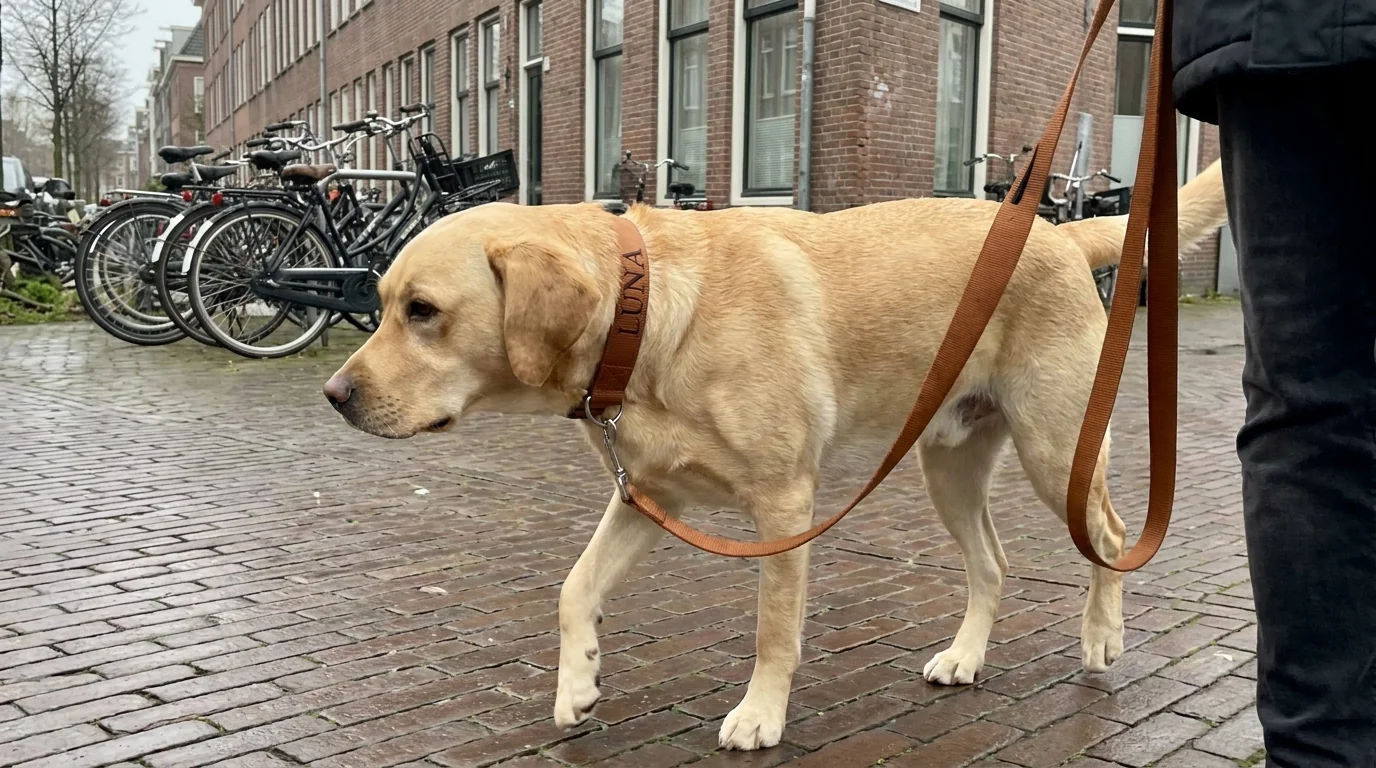
Loose-leash walking is when your dog walks at a calm pace next to you (or just ahead, or just behind, exact position doesn't matter) with the leash hanging in a soft J-shape between you. No pulling. No dragging. No tension. The clip on the collar should swing slightly as you walk, not point straight forward like a tow-rope.
It is not heel work. Heel work is a competition position, dog's shoulder pinned to your knee, eyes up, precise. Loose-leash walking is the everyday version: your dog can sniff the lamppost, pause to look at a cyclist, drift a meter ahead, and then settle back. The deal is simple. The leash stays slack. That's it.
A realistic timeline: this takes about three months of daily practice for most dogs to get reliable, and longer for adolescent dogs or breeds with strong pulling instincts. It is not a weekend fix. It is not a one-session-with-a-trainer fix. It is a small habit you build, five minutes at a time.
Why this is the foundation skill
Almost every other walk-based behavior stacks on top of loose-leash walking. Recall practice on a long line. Polite greetings with strangers. Calm passing of other dogs. Cafe behavior. Off-leash reliability. All of it assumes your dog can move through the world without dragging you, because a dog that pulls is a dog that's already over-aroused before anything interesting happens.
There's a feedback loop people miss. When the leash is tight, the dog is pulling forward into discomfort and getting rewarded for it (they reach the smell, the dog, the corner). Every tight-leash walk teaches the dog: pulling works. Every slack-leash step teaches the opposite. You're not just training a skill, you're untraining months or years of accidental practice in the wrong direction.
The other reason it matters: pressure on the front of the throat from a flat collar, when the dog is actively pulling against it, isn't great for the trachea or thyroid long-term. The fix isn't a different collar (harnesses can make pulling worse if the dog learns to lean into the chest plate). The fix is teaching the dog not to pull in the first place.
The tools you actually need
Three things. That's the whole list.
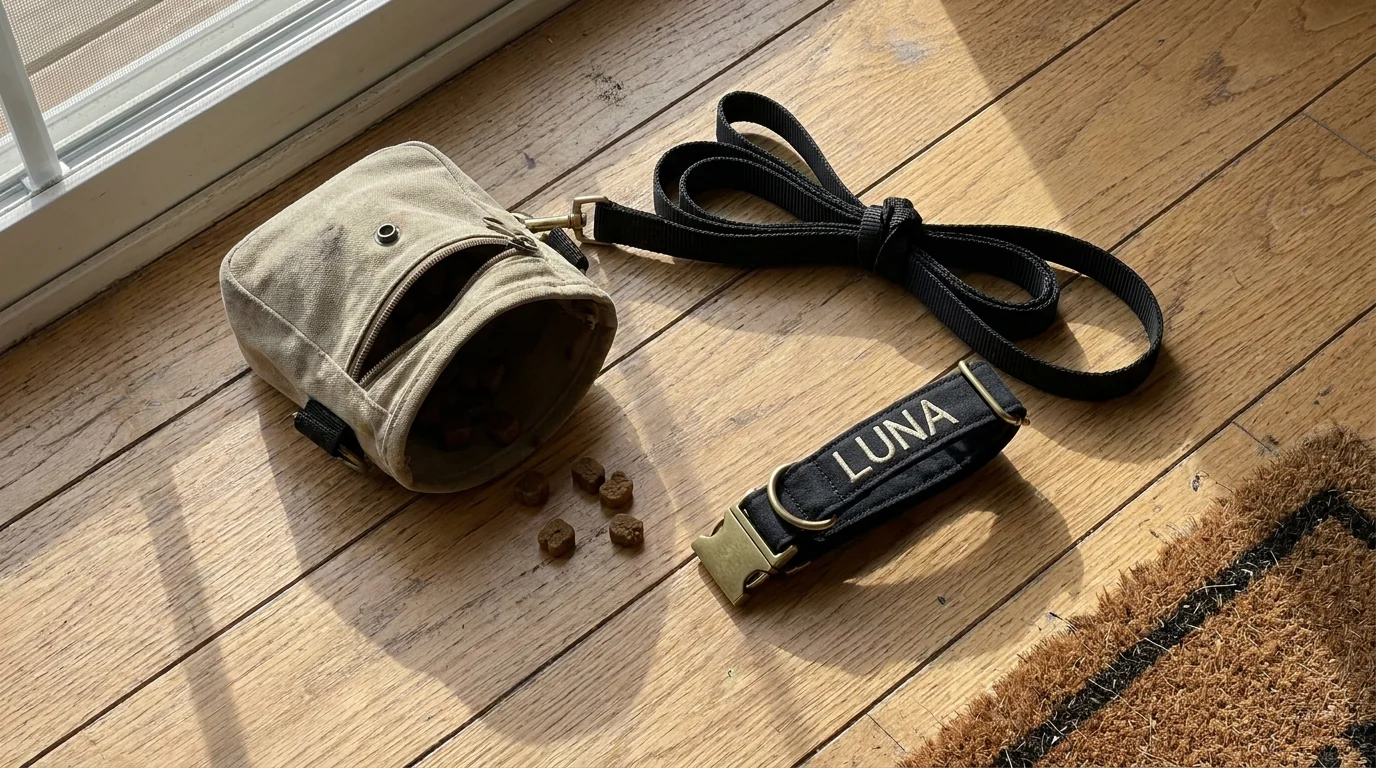
- A flat collar that fits properly. Two fingers should slide between the collar and the neck, snug, not tight. A well-fitted Classic collar (available in 25 mm (L/XL; S/M: 20 mm) and 38 mm widths, depending on the dog's size) gives you a clean, neutral training tool. The zinc-alloy D-ring on the Classic line takes a leash clip without rattling, which keeps distractions down.
- A fixed-length leash, 1.2 to 1.5 meters. Long enough that the dog has slack when walking beside you. Short enough that you're not managing rope. Our Classic leash is 1.4 m, long enough for a sniff detour, short enough to keep your dog out of the road.
- Soft, high-value treats. Cut small. Pea-sized. You'll go through 30 to 50 in a five-minute session, and a dog that's chewing for thirty seconds isn't learning anything.
Why retractable leashes break this skill
Retractable leashes work directly against loose-leash walking. A retractable leash has constant tension on it by design. The spring pulls the cord back toward the handle. So the dog feels light pressure on the collar at all times, which is exactly what you're trying to eliminate. Worse, the dog learns that pulling harder gets them more leash. Pull-and-extend is the only mode. There's no slack-leash reward to teach against.
Retractables have a use, long-line work in open fields for a dog that already knows the rules. They are not a daily-walk tool, and they are not a training tool. If you're working on loose-leash walking, put the retractable in the cupboard for three months.
The five-minute daily practice
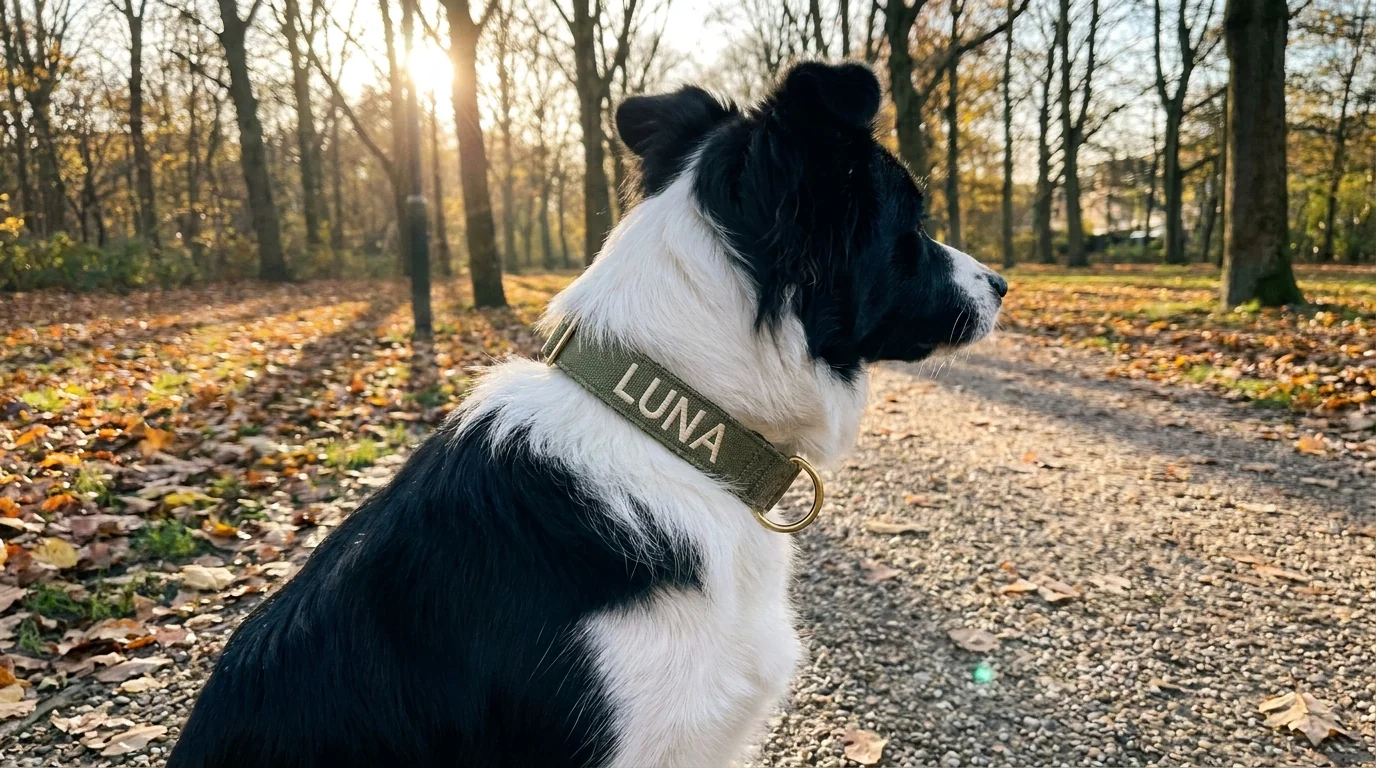
This is the entire method. Don't add to it for the first month.
Step 1: Pick a quiet spot
Your hallway. Your driveway. The empty end of your street at 7 am. The dog cannot learn loose-leash walking on a busy walk where every smell, dog, and child is more interesting than you. Start where the world is boring.
Step 2: Walk forward, treat at your side
Clip the leash on. Hold it in the hand opposite the dog (so if the dog is on your left, leash in your right hand). The treat hand is on the dog's side. Take a step. If the leash stays slack, treat at your hip, not in front of you, not far ahead. Take another step. Treat. Step. Treat. Step. Treat.
You are paying for the absence of pulling, one step at a time. After the first session your dog will wonder what changed and why the treat rate just went up. This is normal.
Step 3: When the leash goes tight, stop
The instant the leash tightens, full stop. Plant your feet. Do not reel the dog in, do not jerk, do not say anything. Just stop being a moving anchor. Wait. The dog will eventually look back at you (this can take ten seconds the first few times, be patient). The moment the leash goes slack, you start walking again and treat for the next slack step.
What you're teaching: pulling stops the walk, slack starts the walk. That's the whole lesson, repeated five hundred times over three months.
Step 4: Five minutes, then stop
End the session before the dog gets bored or saturated. Five minutes of focused practice beats forty minutes of half-attention. Then go on your normal walk on a different leash or in a different mode (a verbal cue like "go sniff" helps mark the transition out of training).
What progress actually looks like
| Week | What you should see | What you should not expect |
|---|---|---|
| Week 1-2 | Dog stays loose for 3-5 steps in your boring spot | Any reliability outside that spot |
| Week 3-4 | 10-15 slack steps in a row, dog checks in with you | Walking past another dog calmly |
| Month 2 | Whole quiet streets on a slack leash, occasional resets | Busy areas, off-leash distractions |
| Month 3 | Most walks slack, real-world distractions handled with one or two stops | Perfection. There is no perfection. |
The verdict on timelines: three months is the realistic middle ground. Easy dogs in calm households can get there in six weeks. Adolescent retrievers, sighthounds, and most terriers will take longer, sometimes five or six months. None of this means you're failing. It means you're training a real animal in a real world.
The most common mistakes
Treating in front of you. If the treat is in front of your body, the dog learns to forge ahead to get it. Treat at your hip, every time. The dog's nose should come to your trouser seam, not to your kneecap.
Talking too much. Constant chatter through the whole session ("good boy, walk nicely, no, no pulling, look at me") gets tuned out quickly. Stay quiet. Let the slack leash and the treat do the talking.
Mixing modes. If you train loose-leash walking on the same leash, in the same gear, on the same walk where you also let the dog drag you to the park because you're tired, the dog learns the rules are random. Random rules don't get learned. Pick training windows. Pick free-sniff windows. Keep them visibly different (use a clear verbal cue or clip a longer leash to a harness back-ring for off-duty walks).
Quitting at week three. Week three is when most people stop, because they thought it would be done by then. Week three is roughly the halfway point. Keep going.
Sizing and gear considerations
A common question when starting loose-leash work is whether to size the collar tighter for training. The answer is no, keep the same fit (two fingers between collar and neck). Pulling is addressed through training, not tighter gear. The dog that walks on a slack leash at month three isn't the one with the tightest collar, but the one with the most consistent routine.
Reactive dogs, dogs with prior leash trauma, and dogs in behavioral rehabilitation often need guidance from a qualified, force-free trainer alongside daily practice. This guide covers the typical case. If your dog lunges, snaps, or freezes on the leash, consult a professional before training on your own.
What to do once you have it
Once your dog walks on a slack leash through your normal routes, the skill needs maintenance, not retirement. Two or three short reset sessions a week, same five-minute format, same boring spot, keep it solid for years. Add distractions slowly: a quieter park, then a busier path, then a market on a Saturday morning. Each new environment is essentially a new context. Drop your expectations back to week-one level for the first session in any new place.
And then you have it: a dog who walks with you, not against you. The leash hangs soft. The collar swings. You can focus on the walk instead of your shoulder. That's the foundation. Everything else gets built on top.
| Size | Neck circumference | Webbing width |
|---|---|---|
| S | 24-35 cm | 20 mm |
| M | 32.5-52.5 cm | 20 mm |
| L | 38-61 cm | 25 mm |
| XL | 44-73 cm | 25 mm |
| Size | Neck circumference | Webbing width |
|---|---|---|
| M | 37-47 cm | 25 mm |
| L | 45.5-61 cm | 38 mm |
| XL | 54.5-79 cm | 38 mm |
| Size | Neck circumference | Webbing width |
|---|---|---|
| XS | 21.5-31.5 cm | 15 mm |
| S | 26-41 cm | 15 mm |
Frequently Asked Questions
7 questionsHow long does it take to teach loose-leash walking?
What length leash is best for loose-leash walking?
Should I use a harness instead of a collar for loose-leash training?
Why doesn't my dog pull on some walks but pulls on others?
Can I use a retractable leash sometimes?
What if my dog ignores treats outside?
Is loose-leash walking the same as heel work?
About this article


Anna writes about day-to-day life with dogs: messy routines, training moments, and everyday habits at home. She shares practical, realistic tips that owners can easily put to use.
This article was drafted with AI assistance and reviewed by Anna de Jong, Practical Living-with-Dogs Writer · Amsterdam. Editorial oversight by Laura de Wit.
Last reviewed:
References (5)
- [1]Pauli, A. M., Bentley, E., Diehl, K. A., & Miller, P. E. (2006). Effects of the application of neck pressure by a collar or harness on intraocular pressure in dogs. Journal of the American Animal Hospital Association, 42(3), 207-211.
- [2]Hunter, A., Blake, S., & De Godoy, M. R. C. (2019). Pulling behavior in pet dogs: an evaluation of training methods and equipment. Journal of Veterinary Behavior, 32, 12-18.
- [3]Herron, M. E., Shofer, F. S., & Reisner, I. R. (2009). Survey of the use and outcome of confrontational and non-confrontational training methods in client-owned dogs showing undesired behaviors. Applied Animal Behavior Science, 117(1-2), 47-54.
- [4]Carter, A., McNally, D., & Roshier, A. (2020). Canine collars: an investigation of collar type and the forces applied to a simulated neck model. Veterinary Record, 187(7), e52.
- [5]Shih, H. Y., Phillips, C. J. C., Mills, D. S., Yang, Y., Georgiou, F., & Paterson, M. B. A. (2020). Dog pulling on the leash: effects of restraint by a neck collar vs. a chest harness. Frontiers in Veterinary Science, 7, 519.
Related Articles

How to Stop Leash Pulling: The Calm, Repeatable Method
A practical, repeatable drill to stop leash pulling on the next walk. U-turn, stop, reward, the technique that does the work, with honest notes on power breeds, harnesses, and why prong collars aren't the answer.

What Is Collar Pressure? Why Fit Matters More Than Gear
Collar pressure is force per square centimeter on a dog's neck. Width, fit, and the two-finger rule matter more than the price tag. Here's how it actually works.

What Is a Power Breed? An Honest Definition
Power breed isn't a slur or a warning label, it's a category of dogs whose strength outpaces the average leash, collar, and grip. Here's what it really means, and what gear actually keeps up.

What Is Leash Pressure? How Dogs Read Tension on the Line
Leash pressure is the tension travelling down your line, and dogs read every gram of it. Here's how constant tension trains pulling, why brief pressure-and-release teaches softness, and how to fix it.

What Is Leash Reactivity? A Plain-English Guide
Leash reactivity isn't aggression and it isn't bad training. It's what happens when a dog can't move away from something stressful. Here's what it actually is, why the leash makes it worse, and what helps.