
What Is Leash Reactivity? A Plain-English Guide

Last updated:
Definition
Leash reactivity occurs when a dog barks, lunges, or fixates on triggers such as other dogs, cyclists, or runners specifically while on leash. Off-leash, the same dog often moves past without issue. Because a leash prevents the dog from creating natural distance, normal tension can escalate into visible frustration or barking.
What leash reactivity actually is
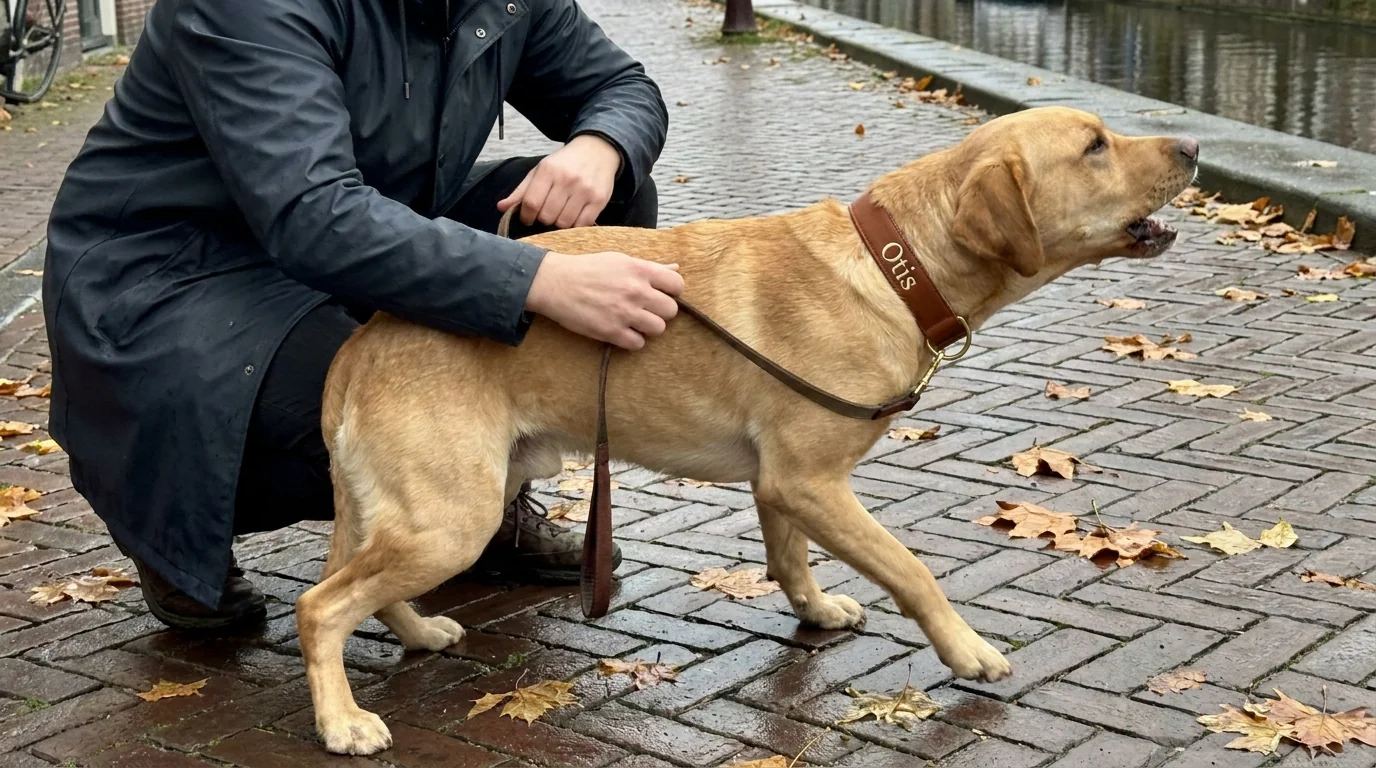
Leash reactivity is a behavior pattern, not a personality trait. A dog reacts, barking, lunging, fixating, sometimes spinning or air-snapping, to a specific trigger while on leash, and would likely ignore that same trigger off leash or behind a fence. It's one of the most common things owners write to us about, usually starting with "my dog is normally so sweet, but…"
The textbook version: a leashed dog can't choose distance. Dogs handle stress by moving, towards or, much more often, away. Take that option away with two meters of nylon and a clip, and the only tools left are fight, freeze, or fidget. Most reactive dogs pick a noisy version of fight, because it works. The trigger usually keeps walking. The dog learns that barking made it go away.
I learned this the hard way with my own dog Otis, who is a perfectly polite Labrador at the dog park and a small, barking disaster the moment a Bichon appears across the canal. Same dog. Different setup.
Frustration or fear? They look almost the same
Trainers and behaviorists generally split leash reactivity into two flavours, and the distinction matters because the fix differs.
Frustration-based reactivity looks like a dog who desperately wants to get to the trigger. Tail high and wagging fast, body forward, vocal but not snarling. Common in friendly, under-socialized, or under-exercised dogs who play well off-leash but can't process a polite hello on a tight line. The leash itself is the problem, they're frustrated they can't say hi.
Fear-based reactivity looks like a dog who desperately wants the trigger to go away. Lower body, weight back or shifting, hard stare, growl-bark, sometimes hackles. The dog isn't trying to start something. They're trying to end something they didn't sign up for.
Plenty of dogs are mixed. The RSPCA and the Dutch Sophia-Vereeniging both note that reactive behavior is almost always emotional, it's communication, not disobedience. Punishing the bark doesn't change the feeling underneath; it usually just makes the dog quieter while the stress builds.
Quick read of the body language
| Signal | Frustration | Fear |
|---|---|---|
| Tail | High, fast wag | Low or tucked, stiff wag |
| Body weight | Forward, on toes | Back or sideways |
| Vocal | Whine-bark, high pitch | Low growl-bark |
| Eyes | Soft, eager | Hard stare, whale eye |
| After trigger passes | Recovers in seconds | Stays alert for minutes |
Verdict: if your dog is loud and bouncy and forgets the whole thing thirty seconds later, you're probably in frustration territory. If they're still scanning the path two corners later, that's fear, and it deserves a slower, gentler plan.
Why the leash makes ordinary dogs look unrecognisable
A loose dog meeting another loose dog has a script. They arc around each other, sniff in a curve, do a little dance, and most of the time it's fine. Dogs are good at this when we let them be.
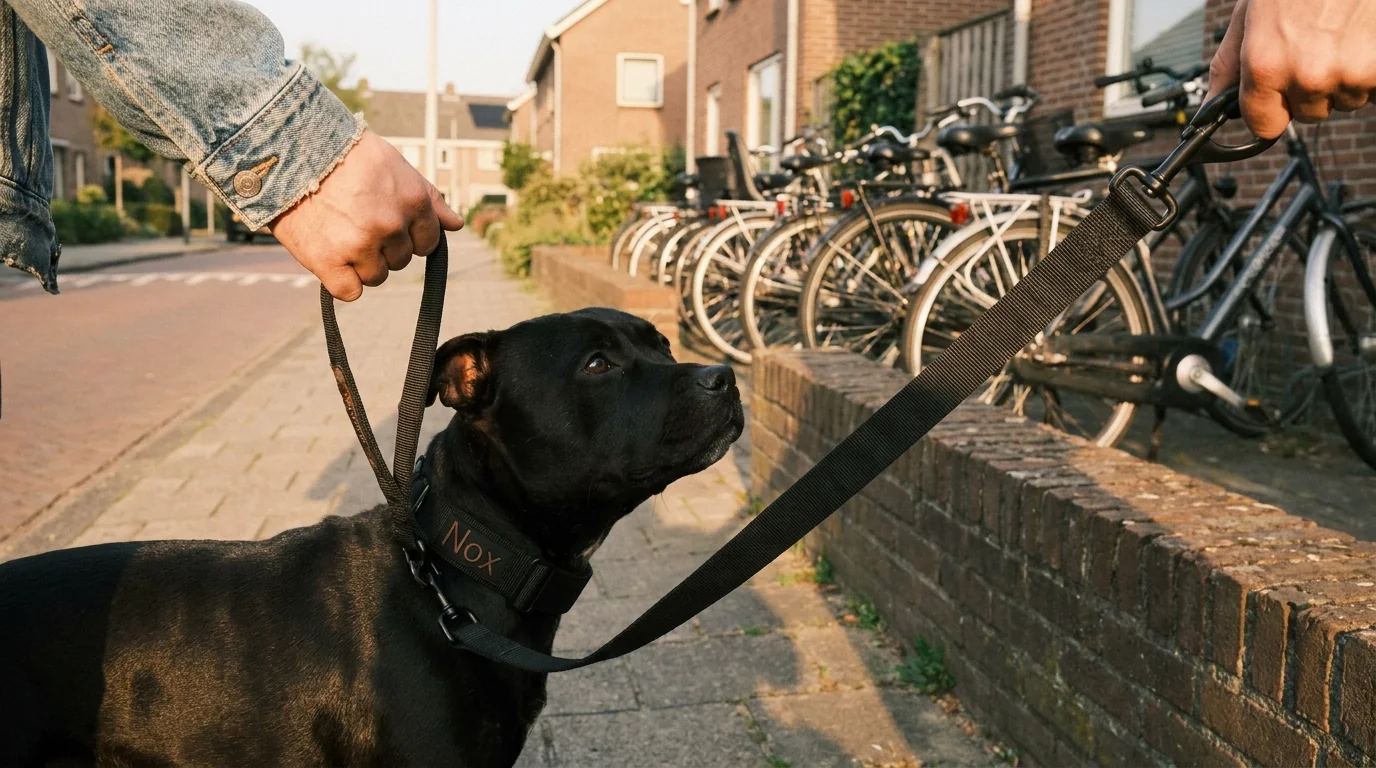
Now add a leash. The dog can't arc. They approach head-on, which in dog grammar is rude or threatening. Tension on the line tilts their posture forward, which looks like aggression to the other dog. The other dog stiffens. Your dog reads that. Both dogs escalate. You haven't done anything wrong, the geometry of leashed walking is just genuinely bad for canine social rules.
Add an owner who tightens the leash because they're nervous (which we all do, it's reflex), and the dog gets a clear signal: my human is bracing, this is the bad thing. A 2019 study in Applied Animal Behavior Science found leash tension correlates measurably with stress signalling in the dog at the other end. The leash isn't neutral. It's a conversation.
What gear can and can't do
Let's be honest with each other: no collar fixes reactivity. Anyone selling you one is selling you something else. Reactivity is a behavior driven by emotion, and emotions get changed by training and time, not hardware.
That said, gear does two real, useful things while you're working on the behavior:
- It keeps everyone safe in the moments when the plan falls apart. A 360 kg-tested Tactical (Squffy product) buckle and a frog clasp rated to 907 kg aren't marketing, they're the difference between a bad five seconds and a vet bill. Power-breed owners know this. A snapped clip on a reactive 35 kg dog is not a story you want.
- It gives you control without escalation. A short integrated control handle on a Tactical collar lets you take in slack instantly without yanking, which keeps you off the leash itself, which keeps tension down, which keeps your dog's stress lower. It's a quieter intervention than reeling in two meters of leash.
What gear cannot do: change how your dog feels about Bichons. That's the trainer's job, and yours.
Why we don't recommend prong, e-collars, or slip leads for reactivity
This is where the studio voice gets a bit Dutch-direct. Aversive tools can suppress the bark in the short term. They don't change the underlying feeling, and there's a real risk the dog learns "the other dog appearing predicts pain", which makes fear-based reactivity worse, not better. The Royal Veterinary College's 2020 review of reactive-dog interventions came down clearly on the side of reward-based desensitization. We agree, and we don't make those tools.
What actually helps (the unglamorous version)
None of this is quick. I'll say that up front so we don't pretend otherwise.
- Distance is your best friend. Every reactive dog has a threshold, the distance at which they notice a trigger but don't yet react. Work below that distance. If your dog explodes at 10 meters, train at 15. Cross the road. Duck behind a parked car. You're not avoiding the problem; you're setting up a situation where your dog can actually learn.
- Pair the trigger with something brilliant. Spotting another dog at 20 meters = chicken rains from the sky. Repeat for weeks. The dog starts to associate trigger-appears with good-thing-happens. This is classical conditioning and it's boring and it works.
- Find a qualified, force-free trainer. In the Netherlands, look for someone certified through the Alpha Hondenscholen network or holding an IAABC, KPA, or PPG credential. A good trainer will watch your specific dog, in your specific neighborhood, and build a plan. We can sell you a brilliant collar; we can't read your dog from Veghel.
- Manage the environment while you train. Quiet routes, off-peak hours, parked-car blockers, the other side of the canal. Every reaction is practice; every avoided reaction is a small win.
- Look after yourself. Walking a reactive dog is exhausting and lonely. It's not a reflection of your training, your love for the dog, or your worth as an owner. Most reactive dogs are well-loved dogs whose nervous systems just need more help.
From our studio: the most common note we get on Tactical orders for reactive dogs is some version of "I just want to feel like I have a handle on this." Often literally. The control handle on the Tactical line was originally designed for power-breed handling, but it's become quietly popular with reactivity-trainer clients for exactly this reason, it lets the human stay calmer, which lets the dog stay calmer.
Classic vs Tactical for a reactive dog
| Classic | Tactical | |
|---|---|---|
| Width | 20-20 mm (S/M); 25 mm (L/XL) | 25 mm (M); 38 mm (L/XL) |
| Buckle strength | Standard side-release | Tested to 360 kg |
| Control handle | No | Yes, integrated |
| Best for | Mild frustration in small/medium dogs | Larger dogs, fear-based, power breeds |
| Length range | 21.5 - 65 cm | 32 - 79 cm |
Verdict: if your reactive dog is over about 15 kg or you're worried about a hard lunge, go Tactical. The control handle alone earns its place, it's the single most-mentioned feature in the messages we get from owners working through reactivity. Smaller dogs and milder cases do fine on a Classic, ideally paired with a well-fitted harness for actual training sessions.
What we honestly don't know
We don't know exactly why two dogs from the same litter, raised in the same home, end up wildly different on leash. Genetics play a role. Early socialization plays a role. One scary encounter at fourteen weeks plays a role. The current research suggests it's almost always a mix, and prediction at puppy stage is unreliable.
We also don't know what works for every breed and every dog. This guide covers the common case. If your dog has bitten, has a bite history, or is escalating despite force-free training, you need a veterinary behaviorist, not a blog post and not a collar. There's no shame in that referral. It's the same as seeing a specialist for any other health issue.
Reactivity is rarely cured. It's usually managed, often well, sometimes brilliantly. The dogs we hear about most are the ones whose owners stuck with the boring version of the plan for eighteen months and quietly ended up with a dog who can pass a Bichon at six meters. That's the realistic win.
360 kg / 907 kg: Squffy specification. Test standard and laboratory report not yet published.
| Size | Neck circumference | Webbing width |
|---|---|---|
| S | 24-35 cm | 20 mm |
| M | 32.5-52.5 cm | 20 mm |
| L | 38-61 cm | 25 mm |
| XL | 44-73 cm | 25 mm |
| Size | Neck circumference | Webbing width |
|---|---|---|
| M | 37-47 cm | 25 mm |
| L | 45.5-61 cm | 38 mm |
| XL | 54.5-79 cm | 38 mm |
| Size | Neck circumference | Webbing width |
|---|---|---|
| XS | 21.5-31.5 cm | 15 mm |
| S | 26-41 cm | 15 mm |
Frequently Asked Questions
7 questionsIs leash reactivity the same as aggression?
Will my dog grow out of it?
Should I use a harness or a collar for a reactive dog?
Can I train this myself or do I need help?
Why does my dog react on leash but play fine at the dog park?
Does a tighter leash make reactivity worse?
Is it my fault my dog is reactive?
About this article


Anna writes about day-to-day life with dogs: messy routines, training moments, and everyday habits at home. She shares practical, realistic tips that owners can easily put to use.
This article was drafted with AI assistance and reviewed by Anna de Jong, Practical Living-with-Dogs Writer · Amsterdam. Editorial oversight by Laura de Wit.
Last reviewed:
References (5)
- [1]Shih, H-Y., Paterson, M. B. A., & Phillips, C. J. C. (2019). Stress signals during dog walking and the effect of leash tension. Applied Animal Behavior Science, 215, 64-70.
- [2]Casey, R. A., Loftus, B., Bolster, C., Richards, G. J., & Blackwell, E. J. (2014). Human directed aggression in domestic dogs: Occurrence in different contexts and risk factors. Applied Animal Behavior Science, 152, 52-63.
- [3]Ziv, G. (2017). The effects of using aversive training methods in dogs: A review. Journal of Veterinary Behavior, 19, 50-60.
- [4]China, L., Mills, D. S., & Cooper, J. J. (2020). Efficacy of dog training with and without remote electronic collars vs. a focus on positive reinforcement. Frontiers in Veterinary Science, 7, 508.
- [5]RSPCA (2022). Understanding reactive behavior in dogs: a guide for owners. RSPCA Companion Animal Department.
Related Articles

How to Stop Leash Pulling: The Calm, Repeatable Method
A practical, repeatable drill to stop leash pulling on the next walk. U-turn, stop, reward, the technique that does the work, with honest notes on power breeds, harnesses, and why prong collars aren't the answer.

What Is Collar Pressure? Why Fit Matters More Than Gear
Collar pressure is force per square centimeter on a dog's neck. Width, fit, and the two-finger rule matter more than the price tag. Here's how it actually works.

What Is Loose-Leash Walking? The Foundation Skill
Loose-leash walking is the foundation skill for every dog walk. Here's what it actually means, why retractable leashes undo it, and how five quiet minutes a day beats one long battle.

What Is a Power Breed? An Honest Definition
Power breed isn't a slur or a warning label, it's a category of dogs whose strength outpaces the average leash, collar, and grip. Here's what it really means, and what gear actually keeps up.

What Is Leash Pressure? How Dogs Read Tension on the Line
Leash pressure is the tension travelling down your line, and dogs read every gram of it. Here's how constant tension trains pulling, why brief pressure-and-release teaches softness, and how to fix it.