
What Is Collar Pressure? Why Fit Matters More Than Gear

Last updated:
Definition
Collar pressure is the force a collar transmits to a dog's neck during a pull, measured per square centimeter of contact. Wider webbing spreads that force across more skin, so a 38 mm collar on a 35 kg dog feels measurably gentler than a 25 mm one, even at identical pull strength.
What collar pressure actually means
Collar pressure is the force transmitted to your dog's neck during a pull, divided by the area of webbing in contact with the skin. It's a physics problem before it's a welfare one. Same pull, wider webbing, lower pressure per square centimeter. That's the whole story in one sentence, but the consequences run deep.
Most owners shop collars by color, hardware, or brand. Fair enough. But the variable that actually changes how a collar feels on the neck is width, followed by fit, followed by buckle placement. Material matters less than people think. A well-fitted 38 mm nylon collar will distribute load better than a poorly fitted 25 mm leather one, every time.
The math, in plain language
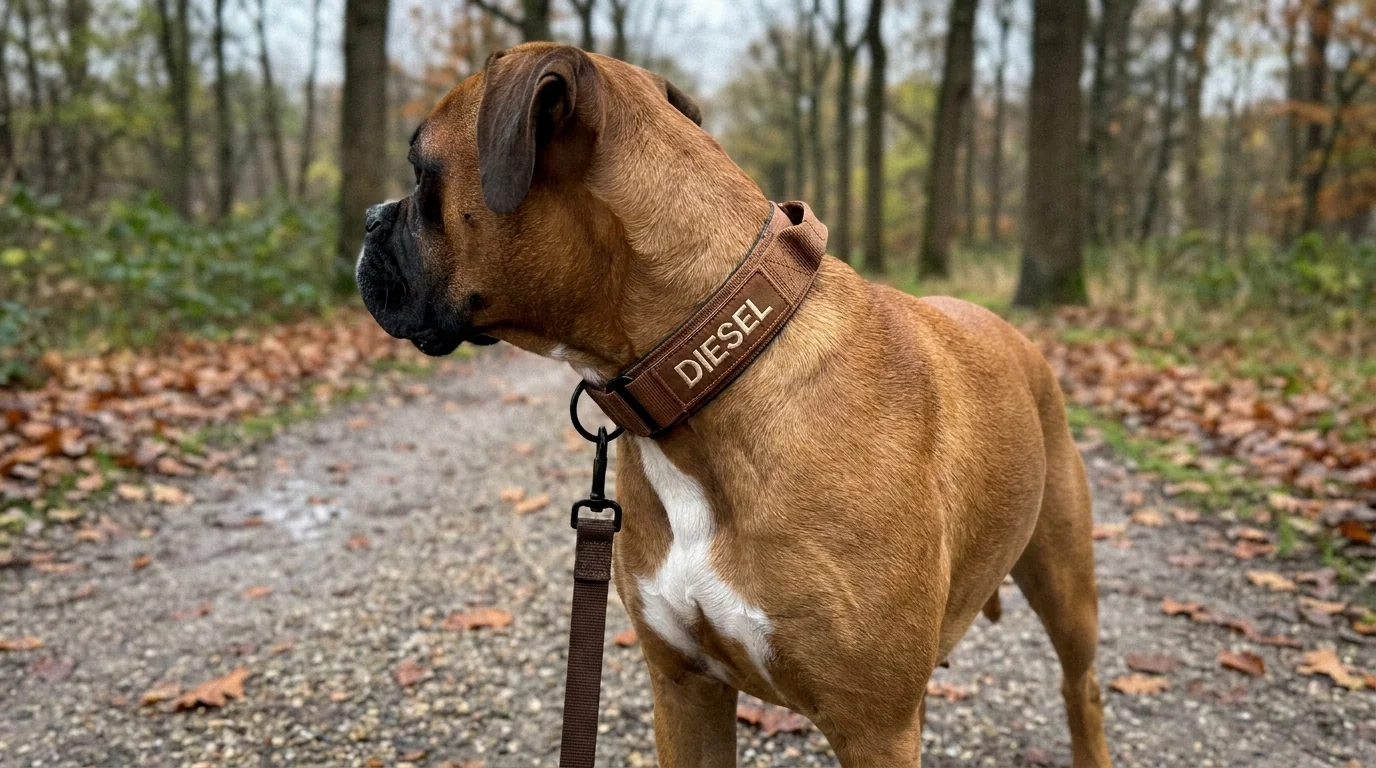
Pressure equals force divided by area. If your 35 kg dog hits the end of the leash with roughly 30 kg of pull (a moderate lunge, not a worst case), and the collar is 25 mm wide, the contact patch on a typical neck is around 60 cm². That works out to roughly 0.5 kg of force per cm².
Now swap to 38 mm. Same dog, same pull. The contact patch jumps to about 90 cm². Pressure drops to roughly 0.33 kg per cm², a third less load on every square centimeter of skin and underlying tissue. The dog isn't pulling any softer. The collar is just doing more of the work.
Why the difference is bigger than it looks
A 33% reduction in peak pressure matters because soft tissue isn't linear. Below a certain threshold, neck tissue absorbs and rebounds without complaint. Above it, you start compressing the trachea, the jugular grooves, and the lymph nodes that sit just under the jaw. The threshold isn't the same for every dog, but the lower you keep average pressure, the more margin you have on the bad days when your dog spots a cat.
Width vs strength, they're not the same thing
People assume a wider collar means a stronger one. Often true, but not the point. Width is about pressure distribution. Strength is about whether the hardware survives the pull. A 25 mm Classic with a zinc-alloy D-ring will hold a 35 kg dog just fine in terms of breaking load. The question is whether the dog's neck enjoys the experience.
This is the core argument for our Tactical (Squffy product) line on power breeds. The buckle is tested to 360 kg and the frog clasp to 907 kg, but the more useful spec for daily welfare is the 38 mm webbing. Wider, flatter, lower pressure per cm². The strength rating is the safety net. The width is the comfort.
Comparing widths against dog weight
| Dog weight | Recommended width | Squffy line | Why |
|---|---|---|---|
| Under 8 kg | 15 mm (Puppy) | Puppy | Smaller necks, lower pull force, narrower webbing sits without bunching |
| 8-20 kg | 20-25 mm | Classic | Pull forces stay moderate; standard webbing distributes load fine |
| 20-35 kg | 25-38 mm | Classic or Tactical | Depends on pulling habits, calm walker, Classic; reactive, Tactical |
| 35 kg+ | 38 mm (L/XL; M: 25 mm) | Tactical | Peak pressure drops measurably; hardware rated for the load |
Verdict: for any dog over 30 kg, the 38 mm Tactical isn't about looks or marketing. It's about pressure per cm². For a 35 kg dog that occasionally lunges, the wider webbing is a genuine welfare upgrade, not a luxury one.
Why the two-finger rule matters here
Width only helps if the collar is sitting where it should. Too loose and it rides up over the larynx, which is the worst place to apply pressure. Too tight and you've eliminated the give that lets your dog swallow, pant, and turn comfortably.
The two-finger rule (you should be able to slide two fingers flat between the collar and the neck) is a fit check, but it's also a pressure check. A correctly fitted collar sits low on the neck, between the jaw and the shoulders, distributing force across the strongest part of the cervical column. A loose collar shifts forward under load and concentrates that force on the trachea instead.
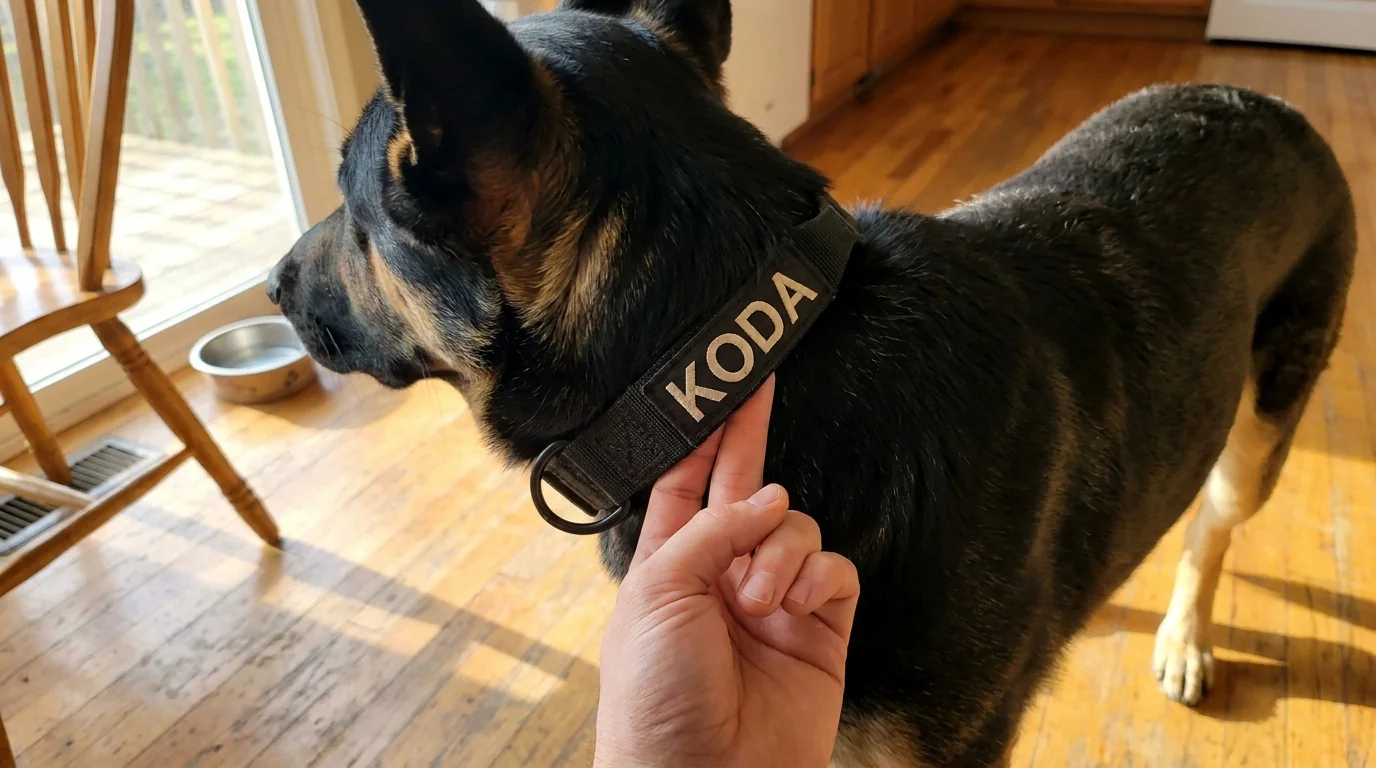
If you want the practical version of the fit check, our companion guide to the two-finger rule covers the step-by-step. This article is the why; that one is the how.
Brachycephalic and tracheal considerations
This is where collar pressure stops being abstract. Some dogs should not be walked on a collar at all, even a wide one. The shortlist:
- Brachycephalic breeds (French Bulldogs, Pugs, English Bulldogs, Boston Terriers) already breathe through compromised airways. Any pressure on the throat reduces airflow further.
- Toy breeds with a history of collapsed trachea (Yorkies, Pomeranians, Chihuahuas, Maltese). The condition is genetic, often progressive, and pressure on the trachea accelerates it.
- Dogs with diagnosed cervical disc disease, laryngeal paralysis, or a history of neck surgery. Talk to your vet, but in most cases, the answer is a Y-shaped harness for walks.
For these dogs, a Squffy collar still has a job: name embroidery, ID tag attachment, the everyday around-the-house wear. Just clip the leash to a harness instead. We don't sell harnesses (yet), and we'd rather tell you that honestly than pretend a wider collar solves a tracheal problem. It doesn't.
From our studio
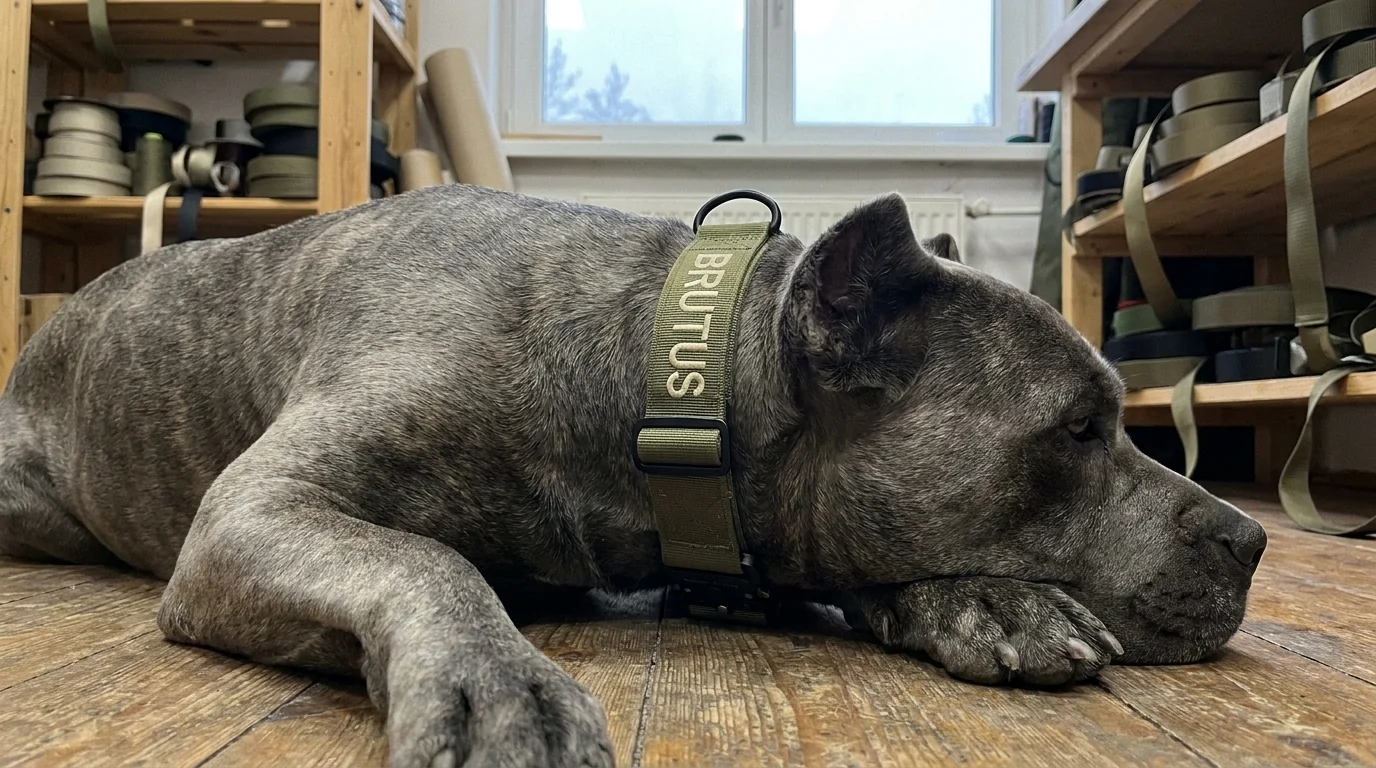
The most common sizing question we get is from owners of 30-40 kg dogs trying to decide between Classic 25 mm (L/XL; S/M: 20 mm) and Tactical 38 mm (L/XL; M: 25 mm). The honest answer is usually: if your dog walks calmly on a loose leash, Classic is fine. If your dog pulls, lunges at squirrels, or you've ever felt the leash snap tight in your hand, go Tactical. Not because Classic will fail, but because the wider webbing is genuinely kinder on the neck across hundreds of small pulls a year.
What collar pressure isn't
A clarification, because the welfare conversation online tends toward the apocalyptic. A well-fitted, appropriately wide collar on a healthy adult dog who walks on a loose leash is not damaging anyone's neck. Dogs have evolved with thick cervical musculature for a reason. The tissue tolerates moderate, occasional load fine.
Where pressure becomes a problem is in three scenarios: chronic pulling on a too-narrow collar, sudden lunges on a collar fitted too high or too loose, and any pressure at all on a dog with a pre-existing airway condition. Address those three, and a collar is a tool, not a hazard.
What we don't know
Honest admission: there's no peer-reviewed study that gives you a clean kg-per-cm² safety threshold for healthy dog necks. The figures in this article are derived from contact-area math and clinical reports on tracheal compression, not from a controlled welfare study. We don't know exactly where comfort tips into harm for any individual dog. What we do know is the direction of the gradient, wider distributes better, fitted correctly distributes better, and some dogs shouldn't be on a neck collar at all. Build from there.
360 kg / 907 kg: Squffy specification. Test standard and laboratory report not yet published.
| Size | Neck circumference | Webbing width |
|---|---|---|
| S | 24-35 cm | 20 mm |
| M | 32.5-52.5 cm | 20 mm |
| L | 38-61 cm | 25 mm |
| XL | 44-73 cm | 25 mm |
| Size | Neck circumference | Webbing width |
|---|---|---|
| M | 37-47 cm | 25 mm |
| L | 45.5-61 cm | 38 mm |
| XL | 54.5-79 cm | 38 mm |
| Size | Neck circumference | Webbing width |
|---|---|---|
| XS | 21.5-31.5 cm | 15 mm |
| S | 26-41 cm | 15 mm |
Frequently Asked Questions
7 questionsDoes a wider collar make my dog look bulkier?
Is a harness always better than a collar?
How tight should a collar be?
Will an embroidered name affect comfort?
My dog wears the collar 24/7, should I worry about pressure?
Does leather distribute pressure differently than nylon?
How do I know if my collar is causing a problem?
About this article


Anna writes about day-to-day life with dogs: messy routines, training moments, and everyday habits at home. She shares practical, realistic tips that owners can easily put to use.
This article was drafted with AI assistance and reviewed by Anna de Jong, Practical Living-with-Dogs Writer · Amsterdam. Editorial oversight by Laura de Wit.
Last reviewed:
References (4)
- [1]Pauli, A. M., Bentley, E., Diehl, K. A., & Miller, P. E. (2006). Effects of the application of neck pressure by a collar or harness on intraocular pressure in dogs. Journal of the American Animal Hospital Association, 42(3), 207-211.
- [2]Carter, A., McNally, D., & Roshier, A. (2020). Canine collars: an investigation of collar type and the forces applied to a simulated neck model. Veterinary Record, 187(7), e52.
- [3]Maggiore, A. D. (2014). Tracheal and airway collapse in dogs. Veterinary Clinics of North America: Small Animal Practice, 44(1), 117-127.
- [4]Hunter, A., Blake, S., & Ferro de Godoy, R. (2019). Pressure and force on the canine neck when exercised using a collar and leash. Veterinary and Animal Science, 8, 100082.
Related Articles

How to Stop Leash Pulling: The Calm, Repeatable Method
A practical, repeatable drill to stop leash pulling on the next walk. U-turn, stop, reward, the technique that does the work, with honest notes on power breeds, harnesses, and why prong collars aren't the answer.

What Is Loose-Leash Walking? The Foundation Skill
Loose-leash walking is the foundation skill for every dog walk. Here's what it actually means, why retractable leashes undo it, and how five quiet minutes a day beats one long battle.

What Is a Power Breed? An Honest Definition
Power breed isn't a slur or a warning label, it's a category of dogs whose strength outpaces the average leash, collar, and grip. Here's what it really means, and what gear actually keeps up.

What Is Leash Pressure? How Dogs Read Tension on the Line
Leash pressure is the tension travelling down your line, and dogs read every gram of it. Here's how constant tension trains pulling, why brief pressure-and-release teaches softness, and how to fix it.

What Is Leash Reactivity? A Plain-English Guide
Leash reactivity isn't aggression and it isn't bad training. It's what happens when a dog can't move away from something stressful. Here's what it actually is, why the leash makes it worse, and what helps.