
What Is a Power Breed? An Honest Definition

Last updated:
Definition
A power breed is a dog whose pulling force, bite strength, and physical drive significantly exceed average handler control, typically 30 kg or more, with working lineage. Think Cane Corso, Rottweiler, Malinois, Bully breeds. Not dangerous by default. Strong by design.
What we mean by 'power breed'
A power breed is a dog whose pulling force, bite pressure, and working drive sit well above the average pet dog, usually 30 kg and up, often with generations of guarding, herding, or working lineage behind it. The term isn't a warning. It's a description of what the gear, the handler, and the training plan need to match.
The honest version: a 45 kg Cane Corso lunging at a passing cyclist is not the same physics problem as a 9 kg cocker spaniel doing the same thing. The dog isn't more aggressive by definition. The forces are just different, and most off-the-shelf collars and leashes are designed around the cocker, not the Corso.
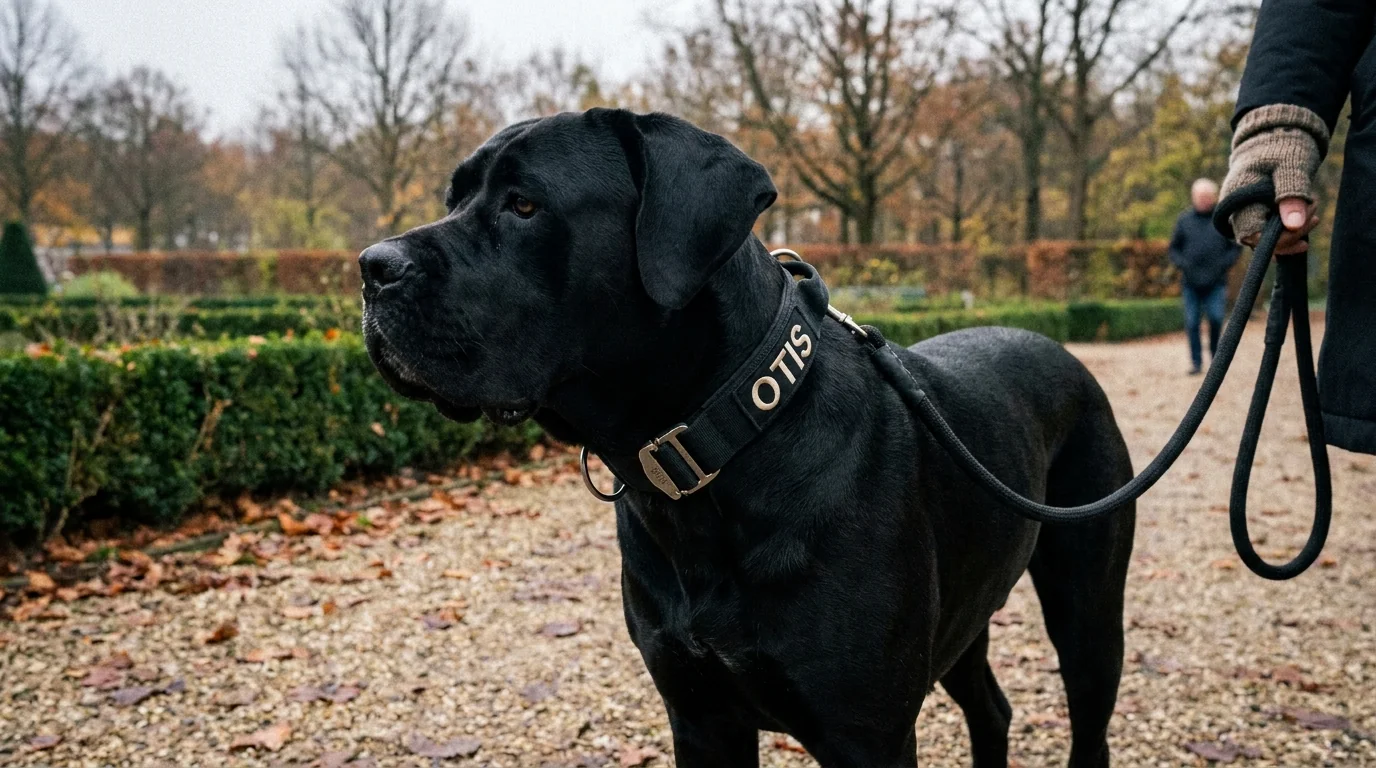
Which dogs actually fit the category?
There's no kennel-club list. The category is functional, not pedigreed. A working-line Labrador can sit firmly inside it; a show-line Rottweiler raised on couches might sit at the edge.
Common breeds that meet the working definition:
- Cane Corso, 40-50 kg, guarding lineage, very high prey drive in some lines
- Rottweiler, 35-60 kg, livestock-drover history, strong neck and shoulders
- German Shepherd (working line), 30-40 kg, sport and police background
- Belgian Malinois, 25-35 kg, lighter than the others but with the highest drive-to-weight ratio in the group
- American Bully and XL Bully types, 30-60 kg, dense muscle, very strong neck
- Dogo Argentino, Presa Canario, Boerboel, 40-60 kg, guarding and hunting lines
- Working-line Labradors and Goldens, 30-40 kg, retriever drive plus genuine pulling power
- Husky and Malamute, 25-45 kg, bred specifically to pull weight for hours
Notice what's missing: 'aggression' isn't on the list. A Malinois trained well by an experienced handler is one of the safest dogs you'll meet on a Dutch sidewalk. The category is about physics, not temperament.
The honest answer to 'are they dangerous?'
The best evidence we have, including the long-running American Veterinary Medical Association reviews and several European bite-incident studies, is that breed alone is a weak predictor of dangerous behavior. Handler experience, socialization, neutering status, and the specific situation matter more. (Patronek et al., 2013, looked at 256 dog-bite-related fatalities in the US and found multiple controllable factors present in over 80% of cases, breed identification was unreliable in roughly a third.)
What's true: when a 50 kg dog makes a mistake, the consequences are larger than when a 5 kg dog makes the same mistake. That's not a moral statement about the breed. It's a reason to take training, equipment, and public space behavior seriously.
Why gear sized to small dogs fails on big ones
This is where the conversation gets concrete. A 25mm-wide nylon collar with a plastic side-release buckle is fine on a 12 kg beagle. Put it on a 45 kg Rottweiler that decides to chase a cat across a street, and you're looking at three failure points: the buckle (rated maybe 50-80 kg of pull), the stitching at the D-ring (often the first thing to go), and the leash clip itself.
Here's a comparison that matters:
| Component | Standard pet collar | Squffy Tactical (Squffy product) |
|---|---|---|
| Width | 15-20 mm (S/M); 25 mm (L/XL) | 25 mm (M); 38 mm (L/XL) |
| Buckle rating | ~50-80 kg | 360 kg tested |
| Leash clip rating | ~100 kg | 907 kg (frog clasp) |
| Control handle | None | Integrated |
| D-ring stitching | Single bar-tack | Box-stitched, reinforced |
The verdict: a Tactical collar isn't overkill. It's the first piece of gear that genuinely matches what a 45 kg working dog can produce in a single committed lunge. Standard pet hardware was never engineered for that load.
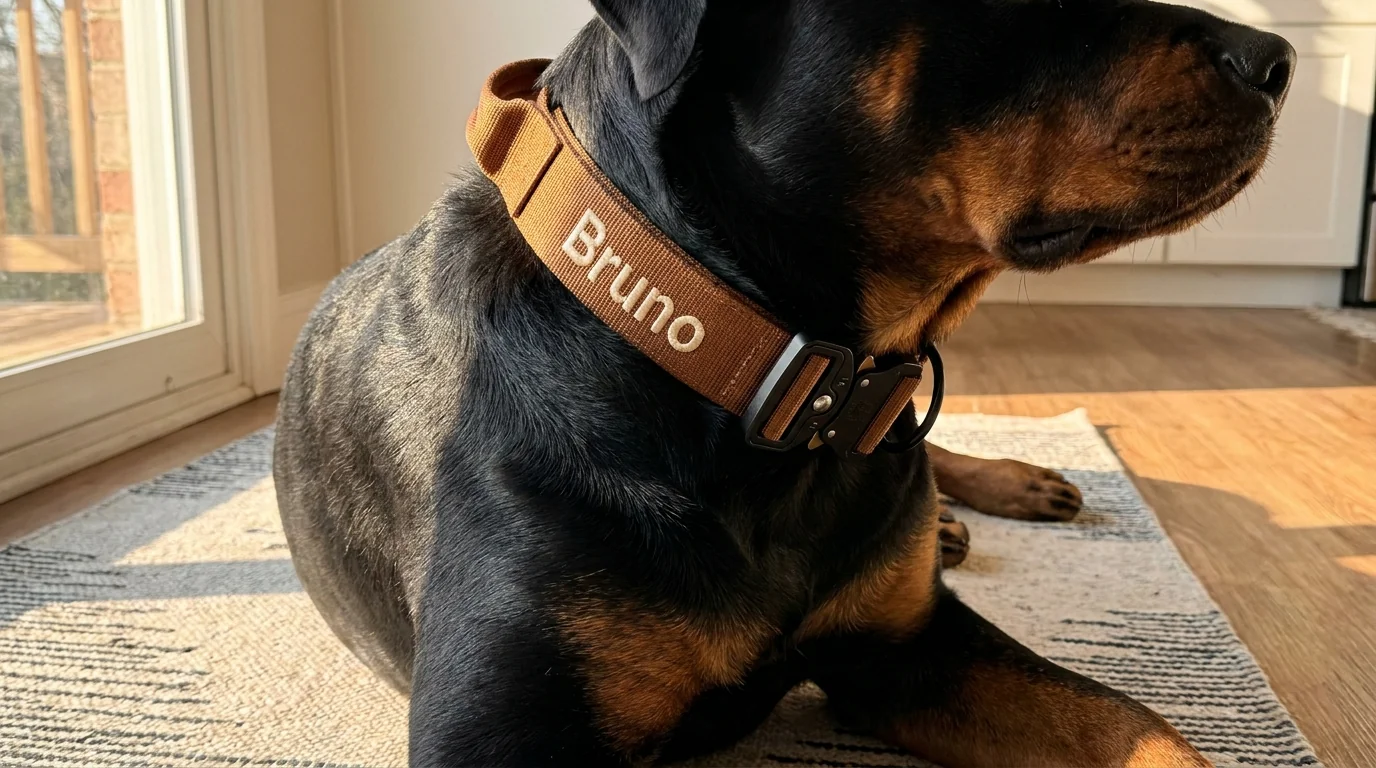
What 360 kg and 907 kg actually mean
From our studio: customers ask us roughly once a week whether the kg ratings are real, or just marketing. They're real, and they're conservative. The 360 kg figure is the buckle's tested static load before mechanical failure. 907 kg is the frog-clasp working load on the leash side.
For context, even the most committed lunge from a 50 kg dog produces a peak load of around 100-150 kg at the collar, the collar accelerates a body, it doesn't deadlift it. The reason we engineer to 360 kg isn't because dogs pull that hard. It's because the gear has to hold after five years of UV exposure, salt water, mud, scratches, repeated buckle cycles, and the one terrible day when the dog spots a deer at the wrong moment. Margin matters more than peak.
What ownership actually requires
This is the section we won't soften. Owning a power breed is a different commitment from owning a small companion dog. We'd be doing the dogs a disservice to pretend otherwise.
Training, not optional
A power breed without a reliable recall, leash manners, and a 'leave it' that holds under distraction is a problem waiting for a Tuesday. Group puppy classes from 12-20 weeks, then ongoing work with a force-free trainer through adolescence (which in these breeds runs to 24-36 months) is the floor, not the ceiling.
Socialization through the full critical window
The primary socialization window closes around 14-16 weeks. Power breeds with under-socialized early lives are the ones that struggle later, not because of breed, but because of missed exposure. Sounds, surfaces, people of different appearances, other dogs of different sizes. All of it. Early.
Public-space etiquette
The unfair truth: people are scared of your dog whether or not your dog deserves it. Short leash near strangers. Cross the street if a child is nervous. Decline the 'is he friendly?' approach if your dog is having an off day. This isn't capitulating to bias. It's the social contract that keeps these breeds legal and welcome.
Equipment that matches the dog
Collar width matched to neck size (38mm minimum for 30 kg+ dogs). A back-up, most experienced power-breed handlers walk with both a flat collar and a slip lead, or a harness and a collar. ID tag with phone number, always. A leash with an integrated control handle for the moments you need to shorten contact fast.
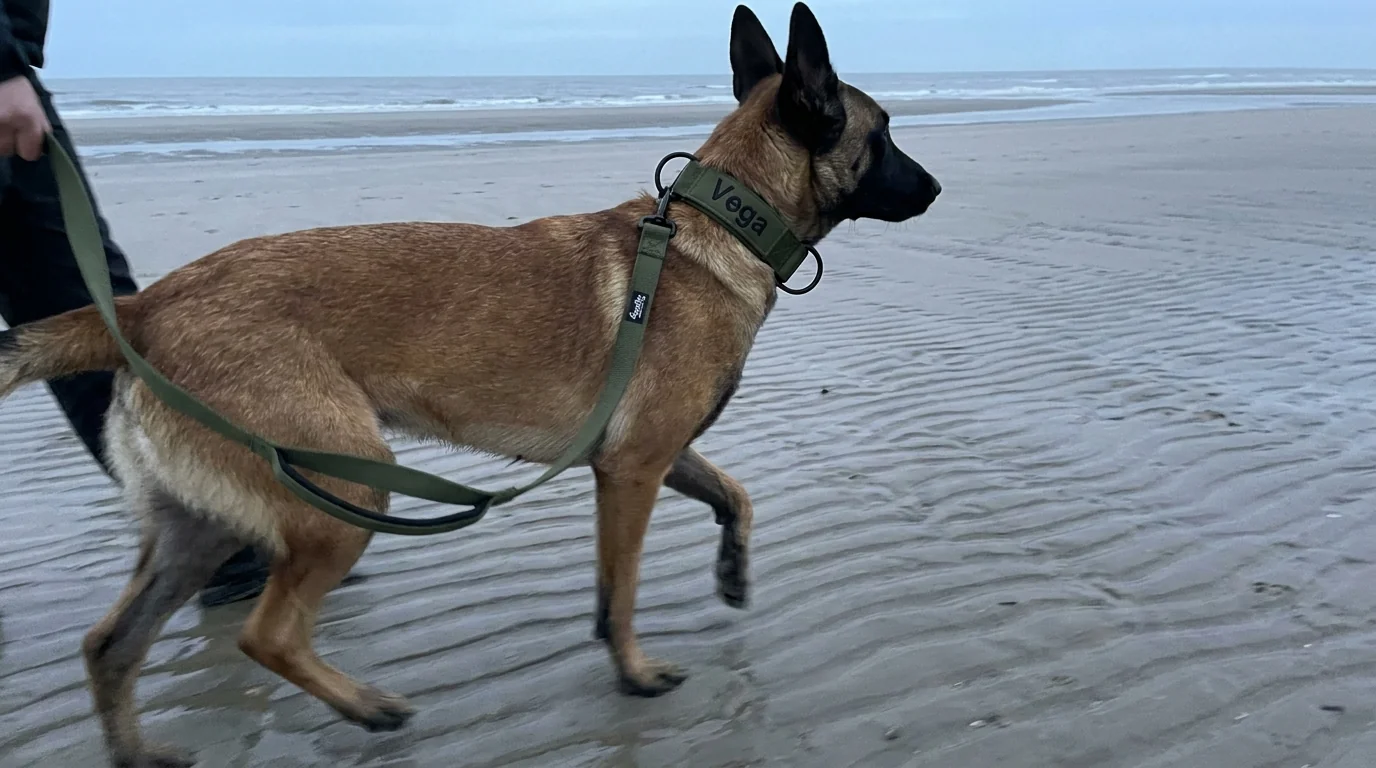
What we don't fully know yet
The research on which breeds really do bite more often is messier than internet arguments suggest. Bite-statistic studies routinely conflate breed identification (often visual, often wrong; Olson et al., 2015, found shelter staff misidentified bully-type breeds in over 60% of DNA-confirmed cases), under-report bites from small dogs (which happen more often but cause less damage), and don't control for handler experience or living situation. We genuinely don't have a clean answer to 'is breed X more dangerous than breed Y'. We have an answer to 'is a 45 kg dog more capable of harm than a 5 kg one', and that's a physics question, not a temperament one.
The bottom line for gear
If you have a power breed, the best collar isn't the cutest one or the cheapest one. It's the one engineered for the load your dog can produce on its worst day, made of materials that won't degrade through five winters, with hardware that's been tested to a margin you'll never actually need. That's the design brief behind the Tactical line, 38 mm (L/XL; M: 25 mm) webbing, 360 kg buckle, 907 kg frog clasp, integrated control handle, embroidered in our Dutch studio one collar at a time.
For a 12 kg cocker spaniel, that's overkill. For a 45 kg Rottweiler, it's the floor.
360 kg / 907 kg: Squffy specification. Test standard and laboratory report not yet published.
| Size | Neck circumference | Webbing width |
|---|---|---|
| S | 24-35 cm | 20 mm |
| M | 32.5-52.5 cm | 20 mm |
| L | 38-61 cm | 25 mm |
| XL | 44-73 cm | 25 mm |
| Size | Neck circumference | Webbing width |
|---|---|---|
| M | 37-47 cm | 25 mm |
| L | 45.5-61 cm | 38 mm |
| XL | 54.5-79 cm | 38 mm |
| Size | Neck circumference | Webbing width |
|---|---|---|
| XS | 21.5-31.5 cm | 15 mm |
| S | 26-41 cm | 15 mm |
Frequently Asked Questions
7 questionsIs 'power breed' a legal classification?
Can a small dog be a 'power breed'?
Do I really need a 360 kg buckle for my dog?
Are power breeds harder to train than other dogs?
Is a harness or a collar better for a power breed?
What collar width should I use for a 40 kg dog?
Will a Tactical collar look aggressive in public?
About this article


Laura focuses on dog behaviour, communication, and animal welfare. In her articles, she explains why dogs behave the way they do and how owners can better understand their pets with calm, practical insight.
This article was drafted with AI assistance and reviewed by Laura de Wit, Dog Behavior & Welfare Writer · Eindhoven. Editorial oversight by Anna de Jong.
Last reviewed:
References (5)
- [1]Patronek, G. J., Sacks, J. J., Delise, K. M., Cleary, D. V., & Marder, A. R. (2013). Co-occurrence of potentially preventable factors in 256 dog bite-related fatalities in the United States (2000-2009). Journal of the American Veterinary Medical Association, 243(12), 1726-1736.
- [2]Olson, K. R., Levy, J. K., Norby, B., Crandall, M. M., Broadhurst, J. E., Jacks, S., Barton, R. C., & Zimmerman, M. S. (2015). Inconsistent identification of pit bull-type dogs by shelter staff. The Veterinary Journal, 206(2), 197-202.
- [3]American Veterinary Medical Association. (2014). The role of breed in dog bite risk and prevention. AVMA Literature Review.
- [4]Duffy, D. L., Hsu, Y., & Serpell, J. A. (2008). Breed differences in canine aggression. Applied Animal Behavior Science, 114(3-4), 441-460.
- [5]Casey, R. A., Loftus, B., Bolster, C., Richards, G. J., & Blackwell, E. J. (2014). Human directed aggression in domestic dogs: Occurrence in different contexts and risk factors. Applied Animal Behavior Science, 152, 52-63.
Related Articles

How to Stop Leash Pulling: The Calm, Repeatable Method
A practical, repeatable drill to stop leash pulling on the next walk. U-turn, stop, reward, the technique that does the work, with honest notes on power breeds, harnesses, and why prong collars aren't the answer.

What Is Collar Pressure? Why Fit Matters More Than Gear
Collar pressure is force per square centimeter on a dog's neck. Width, fit, and the two-finger rule matter more than the price tag. Here's how it actually works.

What Is Loose-Leash Walking? The Foundation Skill
Loose-leash walking is the foundation skill for every dog walk. Here's what it actually means, why retractable leashes undo it, and how five quiet minutes a day beats one long battle.

What Is Leash Pressure? How Dogs Read Tension on the Line
Leash pressure is the tension travelling down your line, and dogs read every gram of it. Here's how constant tension trains pulling, why brief pressure-and-release teaches softness, and how to fix it.

What Is Leash Reactivity? A Plain-English Guide
Leash reactivity isn't aggression and it isn't bad training. It's what happens when a dog can't move away from something stressful. Here's what it actually is, why the leash makes it worse, and what helps.