
What Is Embroidered Dog Gear? A Plain-English Guide

Last updated:
Definition
Embroidered dog gear includes collars, leashes, and accessories where lettering and designs are machine-stitched directly into the webbing with durable thread, rather than printed or engraved. Because the thread integrates into the weave, the embroidery remains clear and legible through years of outdoor walks, weather exposure, and regular washing.
What embroidered dog gear actually is
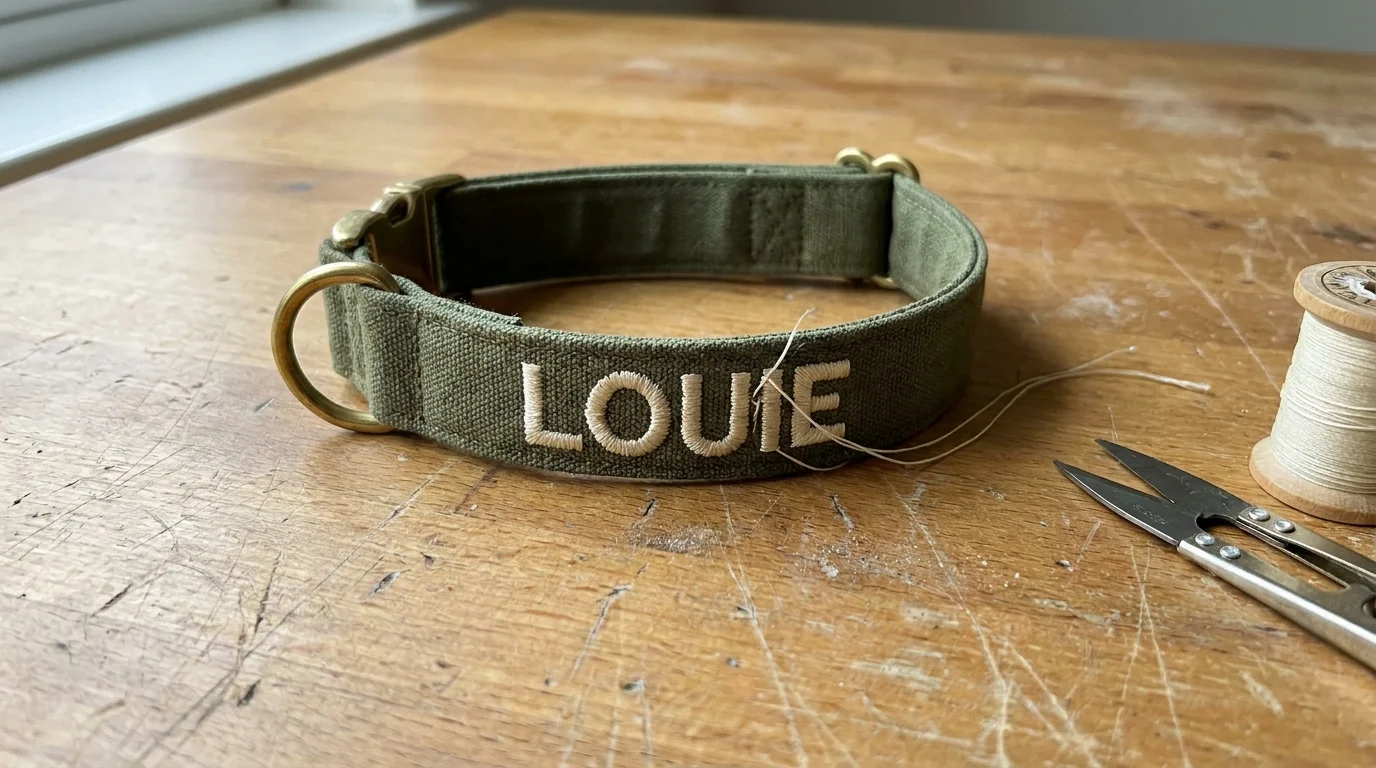
Embroidered dog gear is collars, leashes, and harnesses where the text or pattern is stitched into the webbing with colored thread, using a needle that punches the design straight through the fabric. The thread sits in the webbing, not on top of it. That single distinction, stitched in, not printed on, is the whole reason embroidered gear lasts the way it does.
The word gets used loosely online. Some shops call a heat-pressed nylon strap "embroidered" because there's a faux-stitch pattern in the print. It isn't. If you can scratch the letters with a fingernail and feel a raised line of thread, it's embroidered. If it feels flat and a bit plasticky, it's printed.
How embroidery differs from printing and engraving
Three things tend to get lumped together when people shop for personalized dog gear: embroidery, printing, and engraving. They behave very differently in real life.
Printing puts ink on the surface of the webbing. Engraving cuts into a metal plate or buckle. Embroidery stitches thread into woven fabric. Each has its place, but the questions "will this still be readable in three years?" and "will it survive a wet, muddy, salt-air dog?" tend to have different answers.
| Method | Where it lives | Typical lifespan on a dog | Best for |
|---|---|---|---|
| Embroidery | Stitched into the webbing | 5+ years, fades only as the collar itself fades | Names, phone numbers, anything you want readable for the life of the gear |
| Printing | Inked or heat-pressed on the surface | 6-18 months before cracking or fading | Short-term branding, event collars, bandanas |
| Engraving | Cut into a metal tag or buckle | Permanent on the metal, but the metal can wear thin | Tags, ID discs, fixed buckle plates |
The verdict: for a name on the collar itself, embroidery wins. For a separate ID disc, engraving is the right tool. Most dogs end up with both, a name embroidered into the strap and a phone number engraved on the tag. Belt and braces.
Why stitched thread lasts longer than printed ink
The honest answer is mechanical. Printed ink sits on top of the webbing fibres, so anything that abrades the surface, a collar dragging through brambles, a dog rolling on gravel, the rim of a metal water bowl, takes ink off with it. Thread, on the other hand, is woven through the webbing. To remove it you'd have to abrade enough fibre to break the stitches themselves. By that point the collar is finished anyway.
Polyester embroidery thread is also remarkably color-stable. Independent textile-fade testing on polyester sewing threads shows minimal color shift after the equivalent of years of UV exposure. It's why we're comfortable saying the name will still read clearly years into daily wear.
(One small caveat: thread can fray at the very ends of long stitches if a dog actively chews the collar. We trim and back-stitch to prevent this, but no embroidery survives a dog determined to eat it. That's a different problem.)
What's actually possible, and what isn't
Embroidery is wonderful, but it's not a printer. It works best with simple text and clean shapes. The needle has to physically travel between letters, so very intricate designs either look messy or take so long to stitch they aren't economically possible.
Here's what the typical personalization menu looks like at our Veghel studio:
- Up to 10 characters on a standard collar, enough for almost any name. Longer collars can fit a couple more, but readability drops.
- A short list of font choices, two clean sans-serifs (one crisp, one rounded), a warm humanist face, a plump display face, and a script. We keep it small on purpose; more fonts means more risk of one looking awful at small sizes.
- A wide range of thread colors, covering the full spectrum from soft neutrals like White and Cream through to neons and a metallic Gold. Light neutrals tend to dominate on darker webbing; Espresso and Black sit beautifully on lighter shades.
- Single line of text only, multi-line embroidery exists, but on a strap that's 25 mm wide it just looks cramped.
What the process looks like in practice
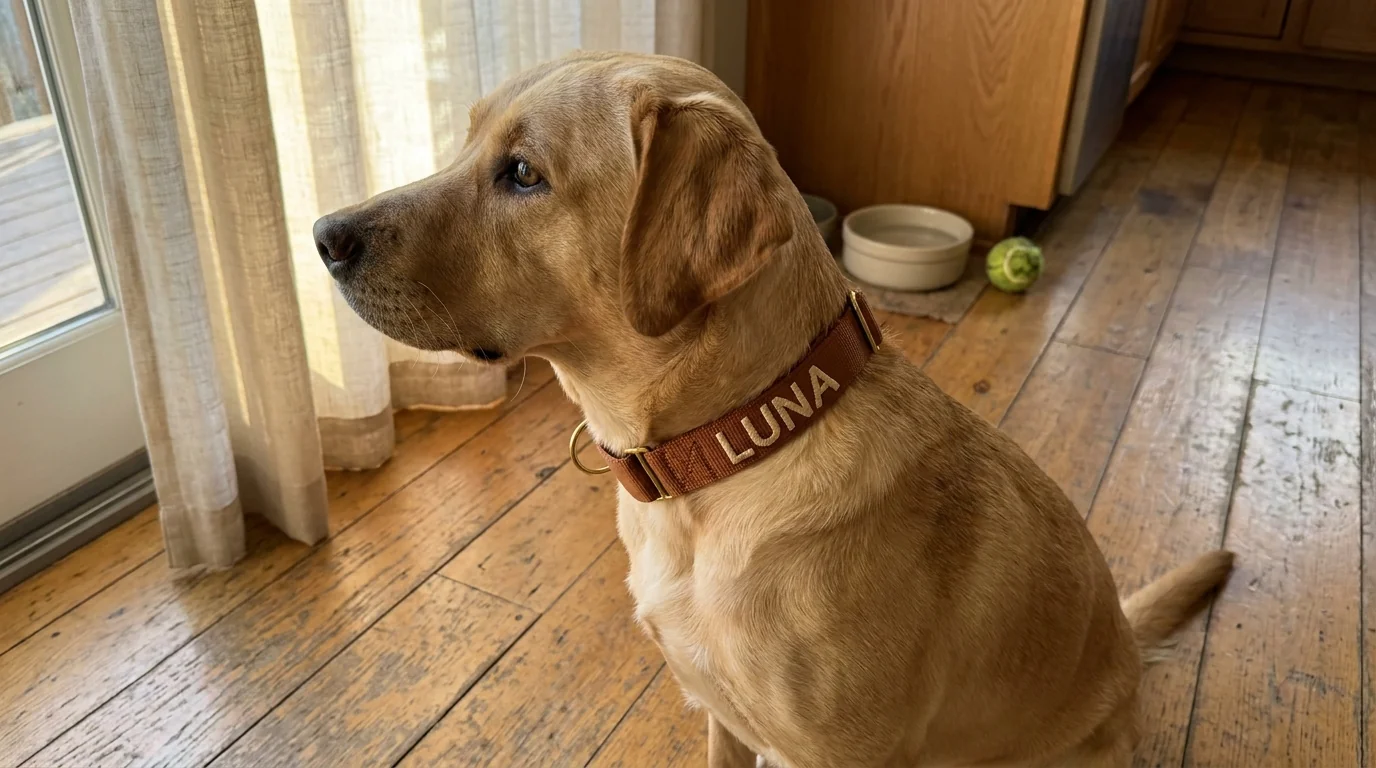
From our studio in Veghel, the workflow is the same on every order. The customer picks line (Classic, Tactical (Squffy product), or Puppy), color, font, thread color, and types the name. That config travels straight to the embroidery machine, which threads up and stitches the design into a pre-cut length of webbing. The strap then gets hand-checked, letters legible, stitch tension even, no loose ends, before the hardware goes on and it ships.
From our studio: the most-asked question we get on personalization is whether to put the name in a light neutral or in the same color as the collar. We almost always say the light neutral, White and Cream are the go-tos. High contrast reads better at distance, which is the whole point of having a name on a collar in the first place.
Where embroidery sits across the Squffy lines
The embroidery itself is the same on every line, same machine, same thread library, same hand-check. What differs is the webbing it goes into.
Classic, style-led
Lifestyle collar, 25 mm (L/XL; S/M: 20 mm) wide, with zinc-alloy hardware. Embroidery here is usually about expression, the dog's name in a font that suits them, in a color that suits the collar.
Tactical, engineered
Built for power breeds. 38 mm (L/XL; M: 25 mm) webbing, tactical buckle tested to 360 kg, frog clasp tested to 907 kg, integrated control handle. Embroidery on this line tends to be more functional, name plus a phone-number fragment, in a light thread on the dark webbing so it reads at a glance from across a field.
Puppy, soft-skin friendly
Lighter webbing, softer edges, sized down. Names embroidered here are often the smallest we stitch: Bo, Mo, Sid, because that's what puppies tend to be called.
Practical limits, what to know before you order
A few things we've learned from stitching a lot of collars and answering a lot of questions:
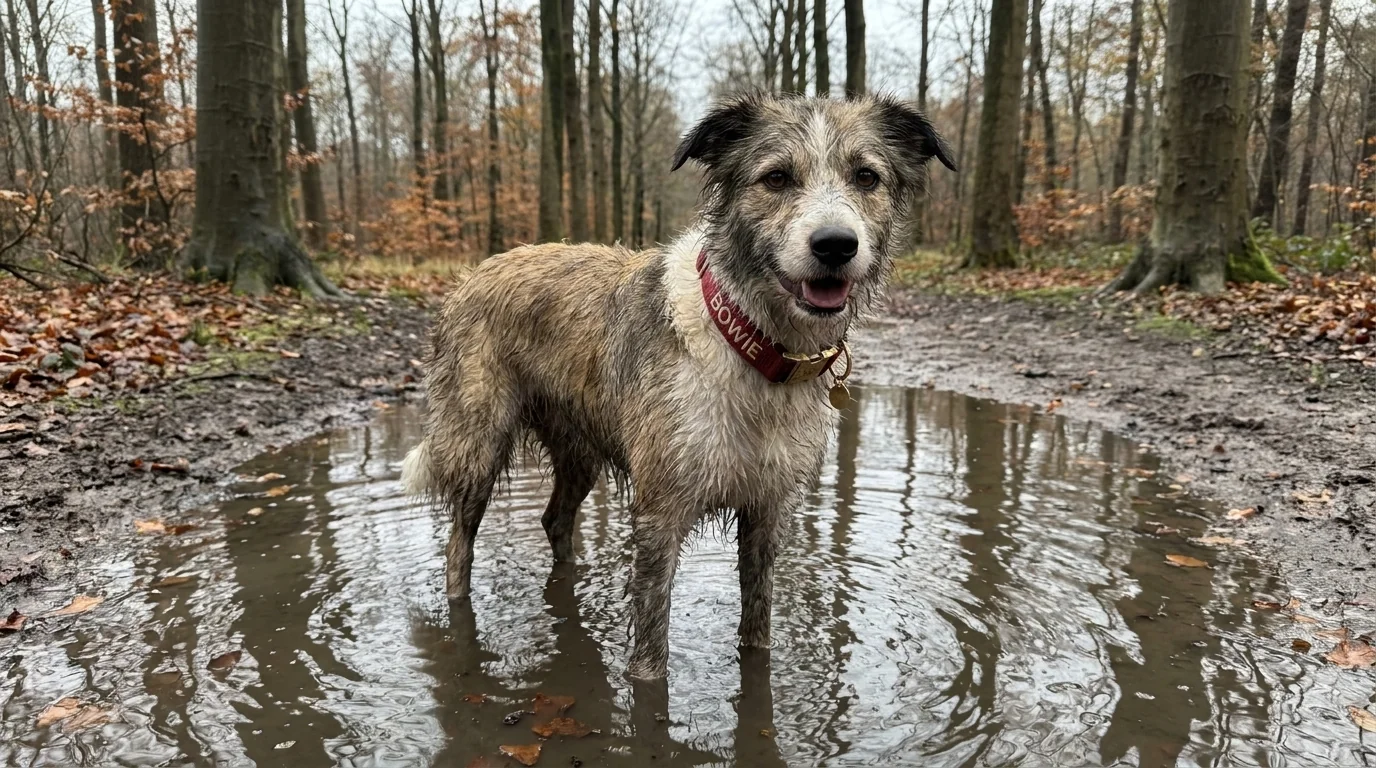
- Very long names get tight. A ten-character name on a 21.5 cm puppy collar will look cramped. If your dog has a long name and a small neck, consider a nickname or initials.
- Light thread on light webbing is hard to read. Tone-on-tone looks elegant in product photos and disappears at six meters in a park. Pick contrast.
- Script fonts read worse at distance. They look beautiful in close-up but blur into a squiggle from across a beach. If your dog regularly disappears into the dunes, go sans-serif.
- Embroidery can't be undone. Once stitched, a name is in. We hand-check before shipping precisely because we can't unpick a finished collar, well, we can, but the webbing is never quite the same.
We don't know which font and thread combination will be right for every dog, the matrix is too big and a lot of it is taste. But the menu we offer has covered every order we've shipped so far, and we'd rather keep it tight and consistent than offer 80 choices that produce 80 inconsistent results.
The short version
Embroidered dog gear is dog gear with the personalization stitched in, not stuck on. It outlasts printing, sits alongside engraving (which still owns the ID-tag job), and gives you a name on the collar that will still read at year three the way it read on day one. Pick a font that matches your dog, a thread color that contrasts with the webbing, and keep the name short enough to breathe on the strap. That's the whole craft.
360 kg / 907 kg: Squffy specification. Test standard and laboratory report not yet published.
| Size | Neck circumference | Webbing width |
|---|---|---|
| S | 24-35 cm | 20 mm |
| M | 32.5-52.5 cm | 20 mm |
| L | 38-61 cm | 25 mm |
| XL | 44-73 cm | 25 mm |
| Size | Neck circumference | Webbing width |
|---|---|---|
| M | 37-47 cm | 25 mm |
| L | 45.5-61 cm | 38 mm |
| XL | 54.5-79 cm | 38 mm |
| Size | Neck circumference | Webbing width |
|---|---|---|
| XS | 21.5-31.5 cm | 15 mm |
| S | 26-41 cm | 15 mm |
Frequently Asked Questions
7 questionsIs embroidered dog gear better than a printed collar with a name?
How many characters can I embroider on a dog collar?
What thread is used for dog collar embroidery?
Will embroidery damage or weaken the collar webbing?
Can I embroider a phone number instead of a name?
How long does it take to embroider a custom dog collar?
Can embroidered text be removed or changed later?
About this article


Anna writes about day-to-day life with dogs: messy routines, training moments, and everyday habits at home. She shares practical, realistic tips that owners can easily put to use.
This article was drafted with AI assistance and reviewed by Anna de Jong, Practical Living-with-Dogs Writer · Amsterdam. Editorial oversight by Laura de Wit.
Last reviewed:
References (4)
- [1]Cui, J., Lewis, R. & Carré, M.J. (2017). Wear and durability of textile webbing in dynamic abrasion conditions. Wear, 376-377, 1922-1930.
- [2]Saville, B.P. (1999). Physical Testing of Textiles. Woodhead Publishing, Cambridge.
- [3]Oğulata, R.T. & Mavruz, S. (2010). Investigation of the color fastness properties of polyester embroidery threads. Fibres & Textiles in Eastern Europe, 18(3), 79-82.
- [4]Carter, A.J., Hall, E.J. & Connolly, S.L. (2020). Pulling on the leash: a review of mechanical forces on the canine cervical spine. Veterinary Record, 186(11), 351-356.
Related Articles

Dog Names That Fit On A Collar
Ten characters on the collar, eight with dog pins, six on Small. Here is which names actually fit, and where the longer ones honestly belong.

Why Diacritics Get Stripped on Embroidered Dog Collars
Why we strip accents from embroidered names: ë, à, ñ, ç turn into thread blobs at 25-38 mm webbing density. An explanation of the trade-off, with real examples and practical alternatives.

The Squffy Thread Colors: How We Picked Them
A complete guide to the embroidery thread colors we offer at Squffy: how we group them, which threads flatter each collar colorway, and how to pick one you'll love in three years.

What is satin stitch? The technique behind name collars
Satin stitch is the embroidery technique behind nearly every personalized dog collar. Here's how it works, why it beats running and chain stitch on nylon, and what separates a clean stitch from a sloppy one.

Machine Embroidery on Nylon Webbing: How It Actually Works
The technical reality of stitching a name into nylon webbing, the digitization step, needle choice, stitch density, why the thread outlasts the webbing color, and the trade-offs we make in our Dutch studio.

Squffy Embroidery Fonts: Everest to Solmere
A walkthrough of the Squffy embroidery fonts (Everest, Havenlock, Brimlow, Rumley, Solmere) with the same dog names imagined in each, plus when to pick which.