
Personalized Collar vs Tag: What to Engrave Where

Last updated:
Definition
A personalized collar carries the dog's name in embroidery, the social, visible piece. A personalized tag carries the recovery info, phone, address, medical notes, engraved on metal. They do different jobs, and most dogs need both. One is identity. The other is insurance.
Two pieces, two jobs
A personalized collar is the dog's identity made visible, their name, stitched in thread, in a font and color you chose. A personalized tag is the boring, brilliant little disc that gets them home when they slip the back gate at 6pm. They look related. They do different jobs. And the most common mistake we see in our studio is owners trying to make one piece do both.
Short version: the collar shows the world who the dog is. The tag tells a stranger how to return them. Mix the two up and you end up with a beautifully embroidered collar reading BOWIE · +31 6 12345678, which looks cluttered, weathers badly, and broadcasts your phone number to every passer-by at the dog park.
What to engrave on the collar
The collar is for the name, and only the name. That's it. Embroidered into the webbing, sized to the collar width, in a thread color that flatters it. BOWIE. Otis. Saar. One word, occasionally two if you have a dog called Mr. Pickles or Lady Wren and you're not sorry about it.
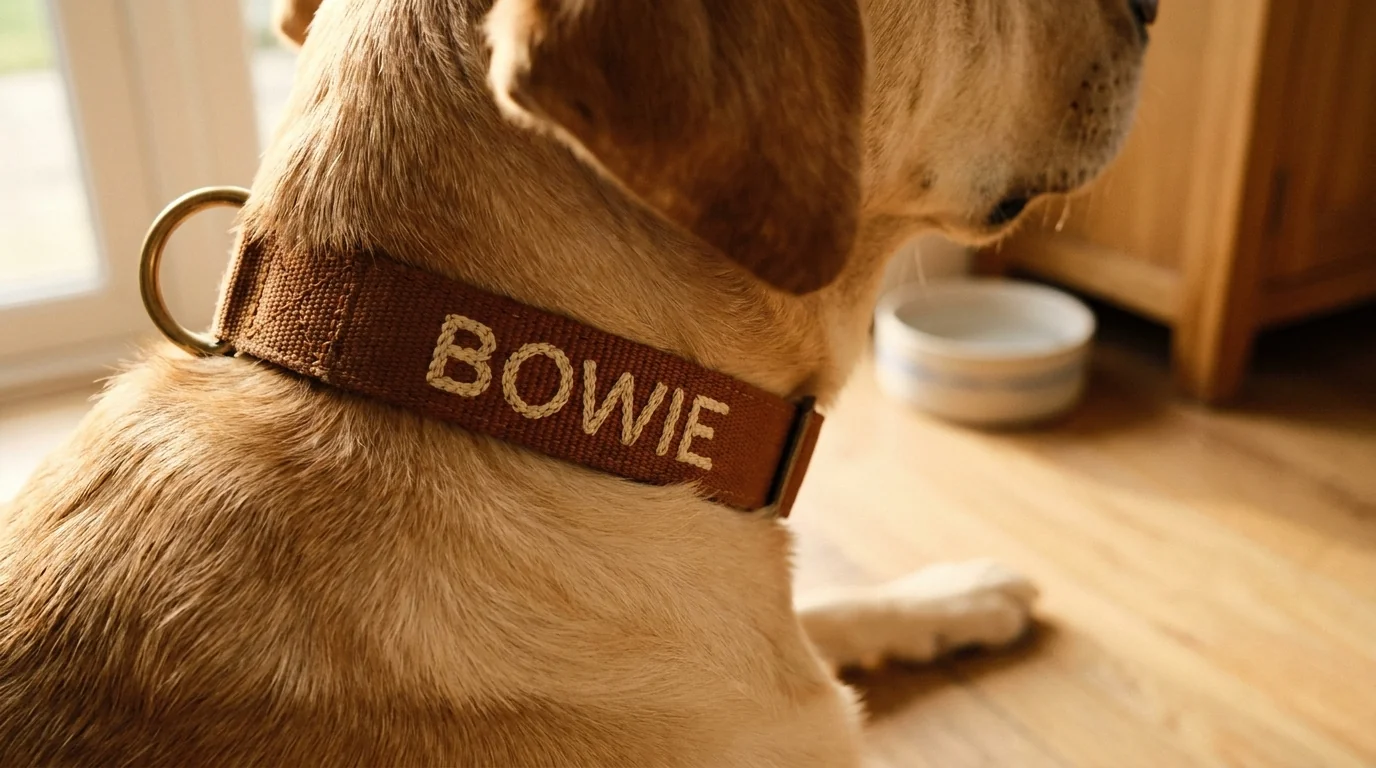
Why only the name? Three reasons.
- It ages well. A name doesn't change. A phone number might. We've reissued collars for owners who moved house, switched providers, or changed numbers after a divorce, and that's an avoidable cost when the number lives on a swappable tag instead.
- It's a social signal, not a security one. When a stranger calls your dog by name in a calm voice, the dog often calms down. That's how the name earns its place on the collar, visible, embroidered, readable from a meter away.
- It's privacy-aware. A collar with your phone number on it is a phone number visible to every passer-by. Most owners don't think about this until someone follows them home from a park, and at that point it's a hassle to undo.
From our studio: the most-requested embroidery is a single first name in 4-7 letters. Anything over 10 characters starts to compress on the 15mm Puppy webbing, and we'll usually email back asking if you want a wider width or a shorter version.
What to engrave on the tag
The tag does the work the collar can't. It's small, metal, replaceable, and built to hold the kind of information that gets a lost dog home. Engrave both sides, the front for who, the back for how.
Front of the tag
- Dog's name (yes, again, a finder may not see the embroidery, especially in a long-coated dog)
- One short identifier if relevant: chipped, deaf, diabetic, needs meds
Back of the tag
- Your mobile number with country code (+31 6 12 34 56 78)
- City or postcode, not full address. Veghel is enough. A finder doesn't need your house number.
- Optional: a second number (partner, vet) if there's room
So the worked example, end to end:
| Piece | What's on it | Why |
|---|---|---|
| Collar (embroidered) | BOWIE | Visible identity. Lifelong. |
| Tag, front (engraved) | Bowie · chipped | Confirms name, signals microchip exists. |
| Tag, back (engraved) | +31 6 12 34 56 78 · Veghel | How to return him. |
Verdict: the collar carries one word; the tag carries five lines. Each piece does the job it's good at, and you can replace the tag without re-stitching the collar.
Why owners get this confused
Because the tag holds the most useful information, and the collar is what people see. Logically, then, owners reach the conclusion that the most useful info should go on the most visible piece. It's a clean argument and it's wrong.
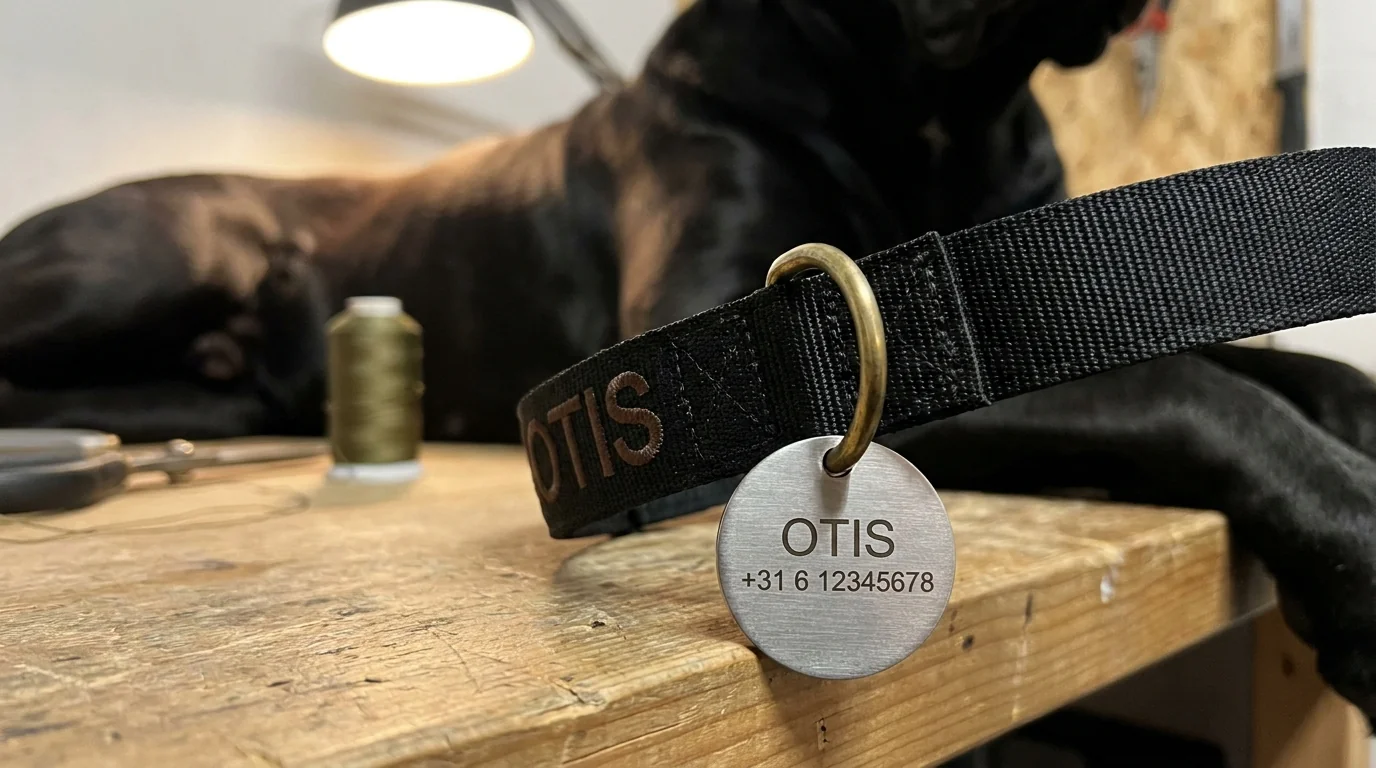
The collar is read at conversational distance, by people. The tag is read at finder distance, by a stranger holding your dog by the scruff at a tram stop, squinting at small text, trying to figure out what to do next. Those are two different reading situations, and they want different content.
Embroidery is also slow to change. A name stitched into webbing is there for the life of the collar, five, eight, sometimes ten years for a Classic line collar that's looked after. Engraving on a tag costs a few euros to redo. Put the changeable info on the changeable medium. Put the lifelong info on the lifelong medium.
Why both is right
A microchip is the legal identifier. A tag is the practical one. A collar with the dog's name is the social one. Each layer fails differently, chips can't be read by a member of the public, tags can fall off, collars can be slipped, and together they form three independent ways for a lost dog to find their way back. Vets and shelter workers consistently report that visible ID (a tag) gets dogs home faster than chips alone, because chips require a scanner and a trip somewhere; a tag requires a phone.
From our studio: we ship roughly as many tags as collars, and a noticeable share of customers add a tag to a collar order in the same checkout. The pairing isn't an upsell, it's how the system is designed to work.
Practical pairings
Classic collar + round engraved tag
Lifestyle pairing. Cognac Brown collar with a cream-embroidered name, 25 mm (L/XL; S/M: 20 mm) round engraved tag with text on both sides. Warm tones together. Reads as styled-but-functional.
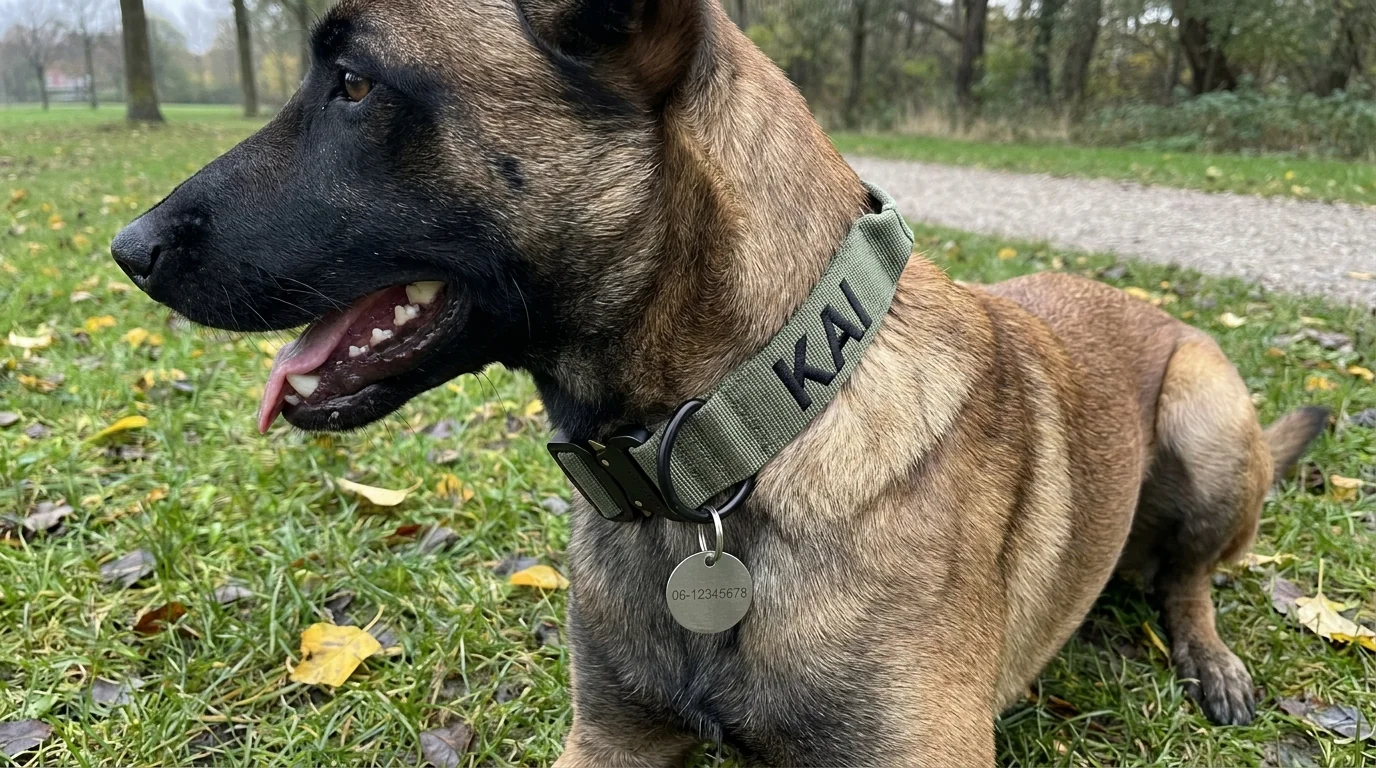
Tactical (Squffy product) collar + stainless tag
For power breeds and working dogs. Midnight Black or Olive Green Tactical collar, 32mm stainless tag with deep-engraved text that survives mud, salt water, and being chewed by another dog at daycare. The Tactical buckle is rated to 360 kg of pull strength; pair it with a tag that doesn't bend the first time the dog rolls.
Puppy collar + small aluminum tag
Puppies grow fast and lose tags faster. A lightweight aluminum tag on a soft Puppy collar means a finder still has a number to call, and you're not paying for stainless on a tag the dog will outgrow in four months. Re-engrave when you size up to an adult collar around the 9-12 month mark.
When to update each piece
| Life event | Update collar? | Update tag? |
|---|---|---|
| You move house | No | Yes, re-engrave city |
| New phone number | No | Yes |
| Dog develops a medical condition | No | Yes, add medical line |
| Puppy outgrows the size | Yes, new collar | Re-use if still legible |
| You rename a rescue dog | Yes, new embroidery | Yes, new engraving |
The rule of thumb: change the tag often, change the collar rarely. That's the whole reason the system splits across two pieces.
One honest limitation
We don't know what works for every dog. A long-coated breed (a Bernese, a Pyrenees) hides embroidery under fur, so the visible-name argument weakens, the tag does more of the social work in those cases. A working dog in a kennel club setting may run multiple collars (a flat one for the day, a slip for the ring, a Tactical for tracking) and only one carries the tag. Adapt the principle, not the prescription.
360 kg / 907 kg: Squffy specification. Test standard and laboratory report not yet published.
| Size | Neck circumference | Webbing width |
|---|---|---|
| S | 24-35 cm | 20 mm |
| M | 32.5-52.5 cm | 20 mm |
| L | 38-61 cm | 25 mm |
| XL | 44-73 cm | 25 mm |
| Size | Neck circumference | Webbing width |
|---|---|---|
| M | 37-47 cm | 25 mm |
| L | 45.5-61 cm | 38 mm |
| XL | 54.5-79 cm | 38 mm |
| Size | Neck circumference | Webbing width |
|---|---|---|
| XS | 21.5-31.5 cm | 15 mm |
| S | 26-41 cm | 15 mm |
Frequently Asked Questions
7 questionsShould I put my phone number on the collar embroidery?
What if my dog loses tags constantly?
Is a microchip enough on its own?
How long does an embroidered name stay readable?
Can I engrave the dog's name on the tag and skip embroidery?
What about QR-code tags?
Should puppies have embroidered names yet?
About this article


Anna writes about day-to-day life with dogs: messy routines, training moments, and everyday habits at home. She shares practical, realistic tips that owners can easily put to use.
This article was drafted with AI assistance and reviewed by Anna de Jong, Practical Living-with-Dogs Writer · Amsterdam. Editorial oversight by Laura de Wit.
Last reviewed:
References (4)
- [1]Lord, L. K., Ingwersen, W., Gray, J. L., & Wintz, D. J. (2009). Characterization of animals with microchips entering animal shelters. Journal of the American Veterinary Medical Association, 235(2), 160-167.
- [2]Weiss, E., Slater, M., & Lord, L. (2012). Frequency of lost dogs and cats in the United States and the methods used to locate them. Animals, 2(2), 301-315.
- [3]American Veterinary Medical Association (2022). Microchipping of Animals FAQ. AVMA Public Resources.
- [4]Slater, M. R., Weiss, E., & Lord, L. K. (2012). Current use of and attitudes towards identification in cats and dogs in veterinary clinics in Oklahoma. Animal Welfare, 21(1), 51-57.
Related Articles

Gold-Tone vs Matte Black Dog Collar Hardware
Gold-tone or matte black hardware on your dog's collar? One is warm and editorial, the other shrugs off scuffs and disappears against the leash. How to choose, and why Tactical comes in only one.

Embroidered vs Printed Dog Collar: Which Lasts Longer?
Printed dog collars are cheap and flexible, but the ink fades fast. Embroidered collars last the life of the webbing. Here's the honest comparison, fade rates, costs, and when each one makes sense.

ID Tag vs Embroidered Collar: Do You Need Both?
Embroidered collar or ID tag, which does your dog actually need? In most of Europe and the UK, the answer is both. Here's the practical breakdown, the legal bit, and what to put on each surface.

Embroidered vs Engraved Dog Collar: A Fair Comparison
Embroidered or engraved? Stitched names are visible at six meters but capped at ten characters. Engraved name plates take any text but can snag a long coat. Here's the honest breakdown.

Classic vs Tactical: Which Squffy Collar Fits Your Dog?
Classic for everyday walkers under 30 kg. Tactical for power breeds, hard pullers, and working dogs. A studio guide to picking the right Squffy collar, with a comparison table, sizing notes, and six honest FAQs.