
ID Tag vs Embroidered Collar: Do You Need Both?

Last updated:
Definition
An embroidered collar carries your dog's name stitched into the webbing, visible at a glance, never falls off. An ID tag dangles from a D-ring with full contact details. They solve different problems, which is why most dog owners need both: one for fast recognition, one for legal compliance.
The short answer: it's not either-or
An embroidered collar is a dog collar with the dog's name (and sometimes a phone number) stitched directly into the webbing. An ID tag is a small engraved disc that hangs from the collar's D-ring. They do different jobs. In the UK, dogs in public are legally required to carry their owner's identification on their collar. Across Europe, identification requirements vary by country, with microchipping widely required.
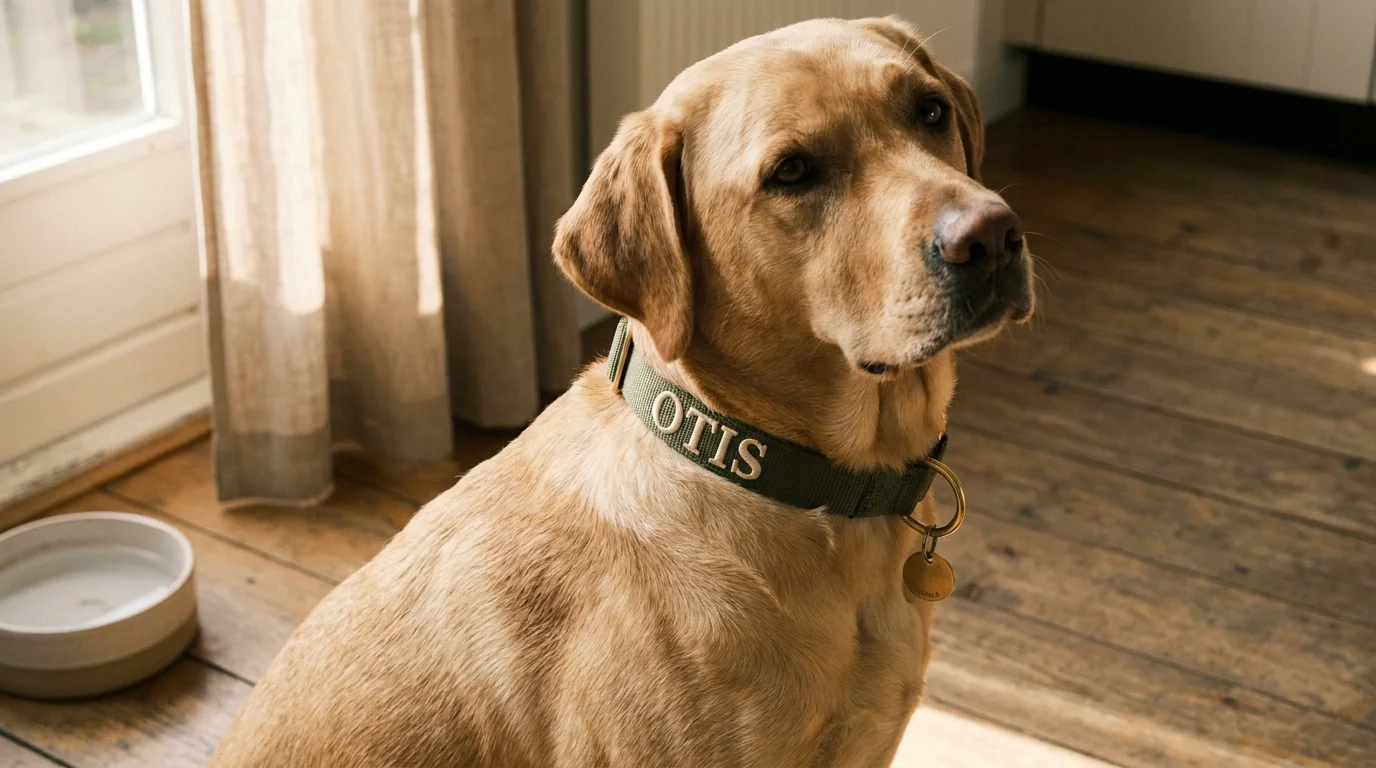
If a stranger finds your dog loose in a park, the embroidered name is what they read first. It calms the dog ("Hey, Otis, come here") and tells the finder this is someone's pet, not a stray. The tag is what gets your dog home, phone number, sometimes address, sometimes a chip ID.
One is for the moment. The other is for the call.
What the law actually says
Most dog owners don't realize the tag is the legally regulated bit, not the collar.
United Kingdom
Under the Control of Dogs Order 1992, every dog in a public place in England, Scotland, and Wales must wear a collar with the owner's name and address on it (or on a tag attached to it). A telephone number is recommended but not strictly required. Failure to comply is a fineable offence, though in practice fines are rare and usually issued alongside a separate incident.
Microchipping has been mandatory since 2016, but, critically, the chip does not replace the collar requirement. The chip helps a vet or warden; the tag helps the neighbour who finds your dog two streets over.
Netherlands and wider EU
The Netherlands has no national "tag law" equivalent to the UK's, but most municipalities require dogs in public to be identifiable, and microchipping has been mandatory for puppies since 2013 (registered via a recognized database within 8 weeks of purchase). In Germany, identification rules vary by Bundesland. In Belgium and France, microchipping is the legal anchor; visible ID is strongly recommended but not always required.
The honest summary: in the UK you legally need an ID tag (or equivalent stitched info). In most of mainland Europe, the chip is the law and the tag is the sensible practical layer on top.
What goes on each surface
Different surfaces, different jobs. Here's how we think about it in our studio when customers ask what to embroider.
| Surface | What to put on it | What to leave off |
|---|---|---|
| Embroidered collar | Dog's name. Optionally one phone number. | Address, chip ID, medical notes. |
| ID tag (front) | Dog's name (matches collar) and primary phone number. | Full home address (security risk). |
| ID tag (back) | Second phone, postcode, "I'm chipped", or "medication needed". | Long sentences. Engraving fades. |
Verdict: embroider the name, engrave the contact details. Don't try to cram a phone number into a 25mm collar, it ages badly, the digits blur after six months of mud and rain, and you'd have to re-stitch every time you change your number.
Why the embroidered name does more than you'd think
It looks decorative. It's not just decorative.
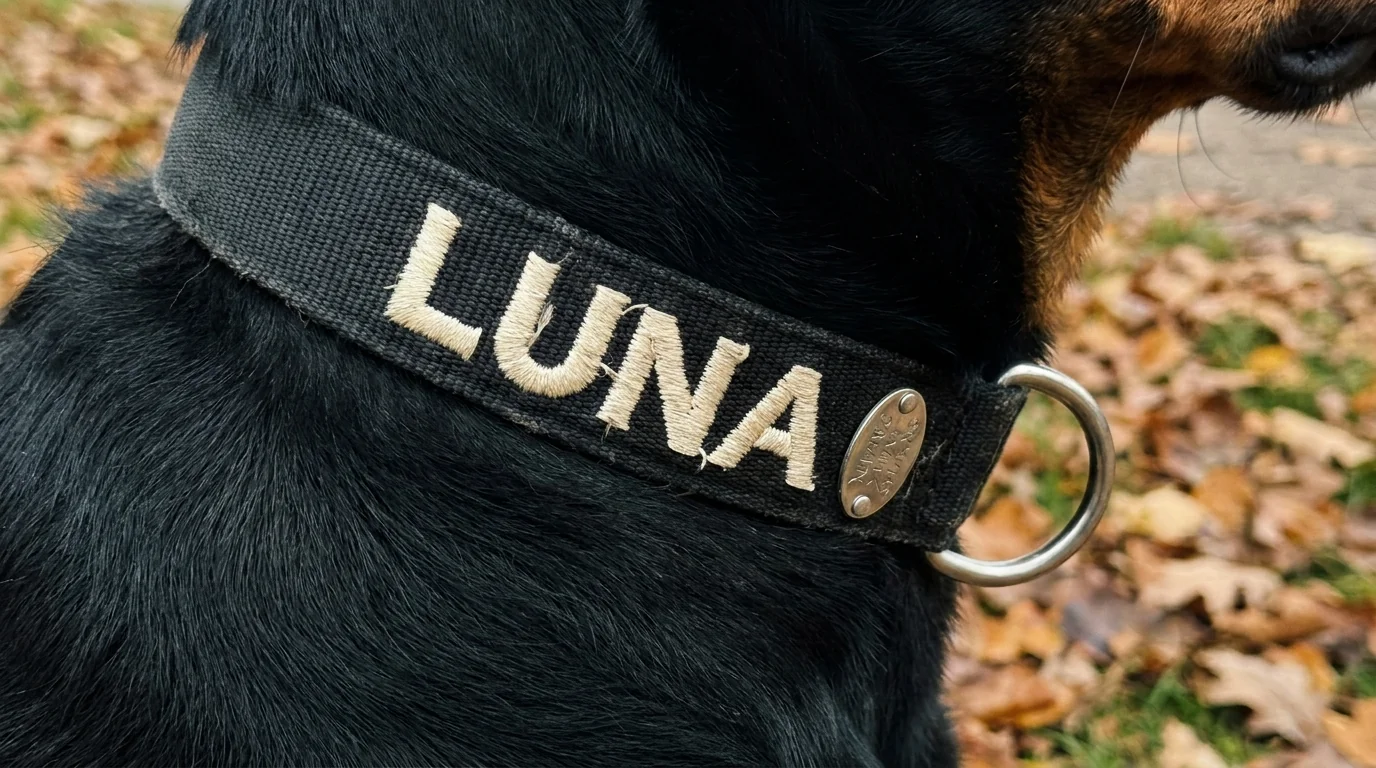
A loose dog in a park is stressed. A stranger calling "Hey buddy!" gets ignored. A stranger calling "Otis, come here, good boy", read off the collar, gets a head turn nine times out of ten. That head turn is the difference between catching the dog and watching it bolt across a road.
Embroidered names also signal ownership instantly. A dog without a collar looks like a stray; a dog with a stitched name looks loved and lost. Strangers behave very differently depending on which they think they're seeing. Industry recovery data consistently shows that visibly identified dogs are reunited with their owners faster than dogs relying on microchip alone, because finders can act on what they can read.
Why the tag still matters
Embroidery is brilliant for visibility. It's terrible for updates.
If you move house, change your phone number, or your dog develops a medical condition that a finder needs to know about, you cannot edit a stitched collar. You replace it. A tag is cheap to replace and takes minutes to re-engrave. That's why the tag carries the volatile information, phone numbers, postcodes, medical flags, and the collar carries the permanent thing: the name.
The other reason tags matter: they're readable in the dark with a phone torch. Embroidery on a black collar at 9pm in a hedge? Almost invisible. A reflective tag with engraved digits? Findable.
Common mistakes we see
Putting the address on the tag
Old advice, increasingly outdated. A stranger finding your dog now has your home address, and so does anyone who reads the tag in a café while you're getting coffee. Postcode + phone is enough. The phone gets you the dog back; the address mostly creates risk.
Relying on the microchip alone
The chip is brilliant once the dog is at a vet, shelter, or warden. It does nothing for the cyclist who finds your dog at 7am and has no scanner. Visible ID bridges that gap.
Tag too big, too noisy, or too small
A heavy tag clatters constantly and most dogs hate it. A tiny tag is unreadable. Aim for a tag roughly 25-30mm across for medium and large dogs, 15-20mm for small breeds and puppies. A tag that sits against the collar webbing rather than against a second tag makes most of the noise go away on its own.
Embroidering a phone number into the collar
Tempting, but think two years ahead. Phone numbers change. Names don't.
From our studio
The most-asked personalization question we get is some version of: "Should I put my number on the collar instead of getting a tag?" Our honest answer, every time: get the tag. Stitch the name. We'd rather sell you a collar that lasts five years than one you have to replace because you switched providers.
We personalize collars and offer tags, so read this with that in mind. A Squffy collar with the name embroidered into the webbing, plus an engraved tag on the D-ring, is the standard setup and it is what most of our regulars run. If you already have a tag you like, keep it. The collar is the part we would not skip.
What we don't know
We don't know your specific local rules, bylaws vary by municipality across the EU, and some UK councils interpret the 1992 Order more strictly than others. If you cross borders regularly with your dog, check the destination country's identification rules before you travel; the EU pet passport scheme covers chips and rabies vaccination, but visible ID is on you.
We also don't know what works for every breed. A Shar-Pei has neck folds that hide a hanging tag. A working Mali on a slip-lead doesn't wear a flat collar at all during training. The advice in this article covers the common case: a pet dog on a regular flat collar.
The standard setup, in one line
Squffy collar with the dog's name embroidered into the webbing. Engraved metal tag on the D-ring with your phone number on the front and a postcode or "chipped" note on the back. Microchip registered to a current address. That covers visibility, legal compliance, and recovery, and it's what we'd put on our own dogs.
| Size | Neck circumference | Webbing width |
|---|---|---|
| S | 24-35 cm | 20 mm |
| M | 32.5-52.5 cm | 20 mm |
| L | 38-61 cm | 25 mm |
| XL | 44-73 cm | 25 mm |
| Size | Neck circumference | Webbing width |
|---|---|---|
| M | 37-47 cm | 25 mm |
| L | 45.5-61 cm | 38 mm |
| XL | 54.5-79 cm | 38 mm |
| Size | Neck circumference | Webbing width |
|---|---|---|
| XS | 21.5-31.5 cm | 15 mm |
| S | 26-41 cm | 15 mm |
Frequently Asked Questions
7 questionsIs an embroidered collar legal as ID in the UK?
Can I just rely on the microchip?
What should I put on the embroidered collar?
Is putting my home address on a tag safe?
How often should I replace the tag?
Do puppies need a tag too?
What if my dog hates the noise of a tag?
About this article


Anna writes about day-to-day life with dogs: messy routines, training moments, and everyday habits at home. She shares practical, realistic tips that owners can easily put to use.
This article was drafted with AI assistance and reviewed by Anna de Jong, Practical Living-with-Dogs Writer · Amsterdam. Editorial oversight by Laura de Wit.
Last reviewed:
References (5)
- [1]The Control of Dogs Order 1992, Statutory Instrument 1992 No. 901. UK Government legislation.
- [2]Lord, L. K., Wittum, T. E., Ferketich, A. K., Funk, J. A., & Rajala-Schultz, P. J. (2007). Search and identification methods that owners use to find a lost dog. Journal of the American Veterinary Medical Association, 230(2), 211-216.
- [3]Weiss, E., Slater, M., & Lord, L. (2012). Frequency of lost dogs and cats in the United States and the methods used to locate them. Animals, 2(2), 301-315.
- [4]Besluit identificatie en registratie van dieren (Identification and Registration of Animals Decree), Netherlands, updated 2013 to include mandatory dog microchipping.
- [5]Microchipping of Dogs (England) Regulations 2015, Statutory Instrument 2015 No. 108. UK Government legislation.
Related Articles

Personalized Collar vs Tag: What to Engrave Where
Owners often confuse the two: the collar is what people see, but the tag holds the info that gets a lost dog home. Here's what to put where, and why both matter.

Gold-Tone vs Matte Black Dog Collar Hardware
Gold-tone or matte black hardware on your dog's collar? One is warm and editorial, the other shrugs off scuffs and disappears against the leash. How to choose, and why Tactical comes in only one.

Embroidered vs Printed Dog Collar: Which Lasts Longer?
Printed dog collars are cheap and flexible, but the ink fades fast. Embroidered collars last the life of the webbing. Here's the honest comparison, fade rates, costs, and when each one makes sense.

Embroidered vs Engraved Dog Collar: A Fair Comparison
Embroidered or engraved? Stitched names are visible at six meters but capped at ten characters. Engraved name plates take any text but can snag a long coat. Here's the honest breakdown.

Classic vs Tactical: Which Squffy Collar Fits Your Dog?
Classic for everyday walkers under 30 kg. Tactical for power breeds, hard pullers, and working dogs. A studio guide to picking the right Squffy collar, with a comparison table, sizing notes, and six honest FAQs.